Best Beaches in Lagos & Alvor, Portugal — Picked by Plan
TL;DR
Lagos held three Blue Flag bathing beaches in 2025 (Meia Praia, Porto de Mós, Praia da Luz) plus the Marina de Lagos as a separate Blue Flag site. Praia da Dona Ana — one of the most photographed beaches in Portugal — is no longer in the Blue Flag set. Praia do Camilo and the Ponta da Piedade headland define the Lagos coast and cannot be skipped. Alvor has Praia de Alvor and Três Irmãos in walking distance from the village. No south-coast beach near Lagos faces directly west: Porto de Mós is south-southwest-facing and is the practical choice for sunset on the sand, but for a true Atlantic-horizon sunset drive 30–40 minutes to Sagres or the Costa Vicentina (Castelejo, Cordoama, Amado). The official bathing season is set annually by APA via Portaria — in 2025 most Lagos and Portimão beaches ran 1 June to 30 September; Albufeira from 15 May. Bus Line 2 from Lagos covers the southern beaches; Vamus Route 47 reaches Salema and Sagres.
Key Takeaways
- •Lagos held three Blue Flag bathing beaches in 2025 (Meia Praia, Porto de Mós, Praia da Luz) plus the Marina de Lagos as a separate Blue Flag site. Praia da Dona Ana, despite being one of the most photographed beaches in Portugal, no longer holds Blue Flag status after artificial sand-fill interventions. Praia do Camilo and the Ponta da Piedade headland define the local coast and are essential context
- •Alvor's two main beaches sit at either end of the village's beach strand: Praia de Alvor (around 4.5 km of calm sand, reachable directly from the village or via the Passadiços de Alvor wooden boardwalk crossing the wetland) and Praia dos Três Irmãos (about 1 to 1.5 km from the village centre, one of the best snorkeling beaches in the Algarve, around three iconic rock formations)
- •Choose by activity, not by name: families pick Meia Praia, Luz, or Martinhal (Sagres) for calm water and lifeguards; snorkelers pick Dona Ana, Camilo, Três Irmãos, or Prainha for clear water and reefs; surfers head to Tonel in Sagres for the most consistent break (improver/intermediate, not a true beginner spot); for sunset on the sand, Porto de Mós is the practical Lagos choice, but for an unobstructed Atlantic horizon you need Sagres or the Costa Vicentina
- •The bathing season ('época balnear') is fixed annually by national regulation referenced by the Agência Portuguesa do Ambiente (APA) — not by the Instituto Hidrográfico. In 2025 the framework was Portaria n.º 205-A/2025/1 of 30 April: Lagos and Portimão beaches ran from 1 June to 30 September, Albufeira from 15 May. Outside the official window beaches remain accessible but unsupervised — Atlantic currents along this coast can be strong
- •Without a car, two networks cover the area: A Onda Bus Line 2 from Lagos serves Meia Praia, Dona Ana, and Porto de Mós (Batata and Pinhão are walking distance from the centre, not bus stops on this line); Line 4 reaches Praia da Luz and Praia do Burgau; the regional Vamus Algarve Route 47 runs Lagos to Sagres with stops at Salema. Praia da Ingrina and Praia do Zavial are the main beaches that effectively require a car
Two Coasts in One Stay
What "Western Algarve" actually means for a guest at Blue Heaven or Alvorada
The Western Algarve is a 50-kilometre stretch of coast running from Ferragudo in the east to Sagres at the southwestern tip of Europe. Within that stretch sit more than thirty named beaches — pocket coves under limestone cliffs, long stretches of fine pale sand, an estuary protected by the Natura 2000 network, and a handful of ocean-facing breaks that work for surf year-round.
The local geography splits into two coasts that sit minutes apart but feel very different. The Barlavento — the south-facing coast where Lagos and Alvor are located — is calmer, sheltered from the dominant Atlantic swell, and noticeably warmer in the water and the air. The Costa Vicentina — the west-facing coast that begins around Sagres and runs north toward Aljezur — is wilder, windier, with bigger waves, lower water temperatures, and a cliff-and-dune landscape protected by the Parque Natural do Sudoeste Alentejano e Costa Vicentina. A guest staying in Lagos or Alvor is on the Barlavento; the Costa Vicentina is a 30-to-50-minute drive away.
For a guest at Blue Heaven in Lagos or Alvorada in Alvor, the choice is rarely about which beach is "best." It is about what kind of day you want. A morning swim with small children, a snorkeling expedition at low tide, a sunset walk along clifftops, an afternoon of paddleboarding through a tidal lagoon — each of these has a clear answer, and none of the answers is the same beach.
This guide is organised by mood and activity, not alphabetically. The aim is to help you choose the right beach for the day you have planned, with practical detail on parking, lifeguards, accessibility, and the small things — sunset orientation, snorkel timing, where to find an amphibious wheelchair — that turn a good beach day into the right one.
The Defining Geography: Ponta da Piedade and Praia do Camilo
The headland that shapes the entire Lagos coast
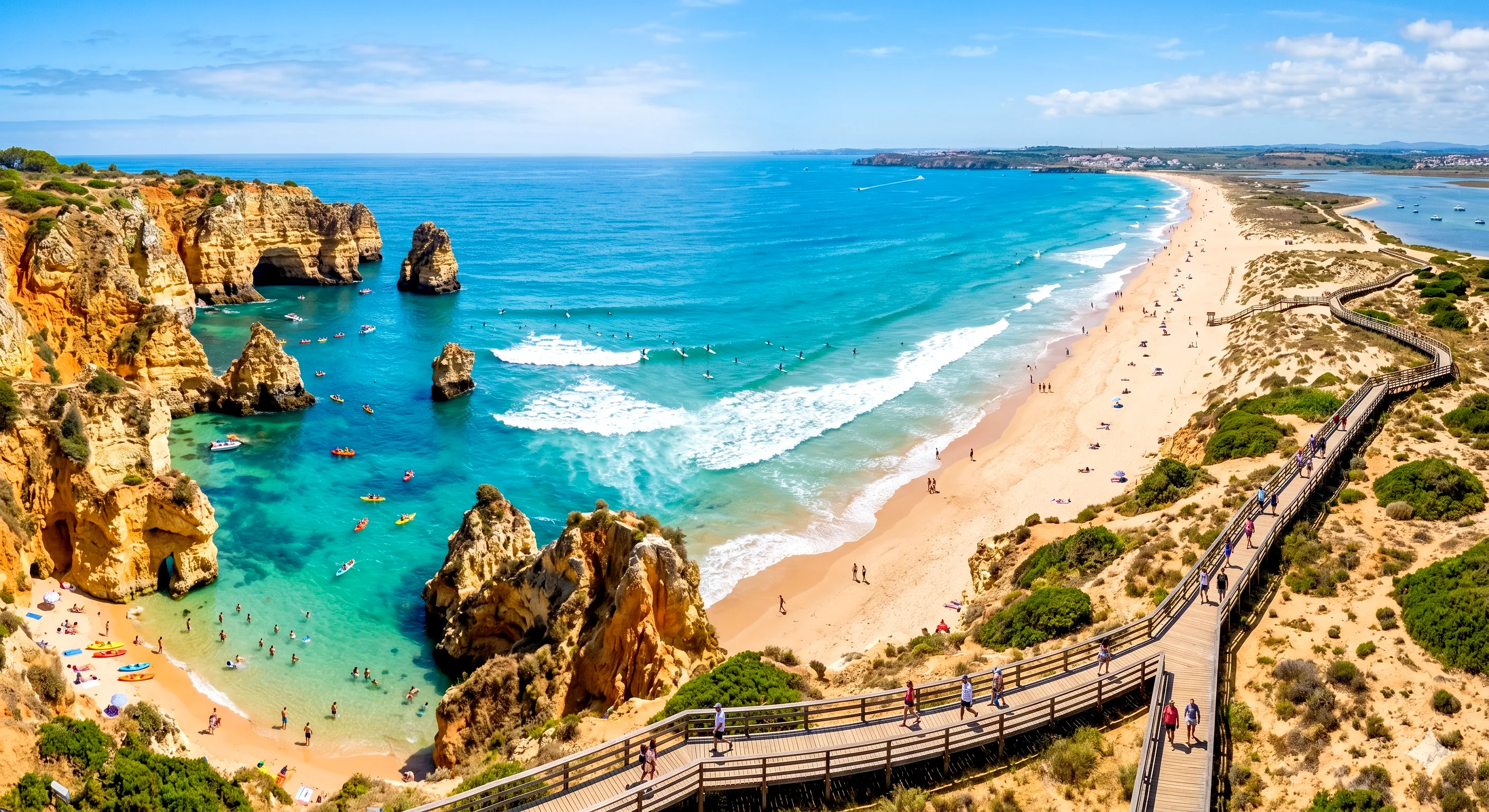
Before the categories, one feature: Ponta da Piedade. The limestone headland that juts south from Lagos is the geological backbone of the entire town's coast. Its sea caves, arches, grottoes, and stacks — sculpted by the Atlantic over millennia — define the postcards of the region and shelter the south-facing beaches from the dominant swell. Most of the beaches in Lagos are pockets cut into this headland or sheltered by it.
The clifftop walk from Praia do Pinhão around the Piedade and on toward Porto de Mós is one of the great walks of the Algarve — better in the late afternoon when the limestone takes on its warm orange tone. From the top, the boat tours that work the grottoes look like toys threading through the rock.
Praia do Camilo is the small cove on the eastern side of the headland, just south of Praia da Dona Ana, reached by a long wooden staircase of around 200 steps. It is one of the most photographed beaches in Portugal — a narrow strip of golden sand between two limestone outcrops, with crystal-clear water and a small rock-cut tunnel connecting the two halves of the beach at low tide. Parking at the top is limited and fills quickly in summer; arrive before 10:00 or take a long walk from town. Facilities are minimal — a small restaurant at the clifftop, no significant changing facilities — and the staircase makes Camilo unsuitable for anyone with mobility constraints. But for a swim in genuinely picture-postcard surroundings, this is the cove.
Family-Friendly: Calm Water, Lifeguards, Facilities
Where to swim with children, the elderly, or anyone who values gentle conditions
Meia Praia is the workhorse family beach of Lagos. Around 4 to 5 kilometres of sand running east from the marina toward the mouth of the Ria de Alvor, with a gently sloping shallow entry, a south-facing aspect that protects it from Atlantic swell, and free parking at multiple entry points. It is walkable from central Lagos in about 15 minutes. The eastern end is a kitesurf and windsurf hub; the western end has the densest concentration of beach bars and sunbed rentals. An amphibious wheelchair is available, and lifeguards work the official bathing season.
Praia da Luz is among the most accessible beaches in the Lagos area. The 700-metre bay sits 8 kilometres west of Lagos (around 10 minutes by car, or A Onda Bus Line 4 from Lagos centre). It is a sheltered, south-facing beach of fine pale sand under low limestone cliffs — calm, family-safe, and a regular Blue Flag beach for many seasons. Wheelchair ramps lead from the parking area to the boardwalk; there are adapted toilets, an amphibious chair, and a pharmacy, grocery shops, and several restaurants within five minutes' walk of the beach. For families with elderly relatives or members with mobility needs, this is a reliable choice.
Praia de Alvor is Alvor's main beach: around 4.5 kilometres of golden sand backed by the Ria de Alvor wetland (Natura 2000 / Ramsar site). The beach is directly accessible from the village in a short walk; for a more scenic approach, the Passadiços de Alvor wooden boardwalks (around 3 kilometres of plank-only structure, more if you walk all the loops) cross the salt marshes and the Ria from the village edge — a walk worth doing in itself, with birdwatching and the smell of pine and tide. The beach has a large free car park, lifeguards in season, beach bars and restaurants, sunbeds, and water sports hire (kayak, SUP, jet ski).
Praia do Martinhal in Sagres is worth the drive west for families with very young children. The bay is sheltered by offshore islets that block Atlantic swell, leaving consistently calm and clear water. There is free parking, lifeguards in summer, a beachfront restaurant and bar, sunbeds, and toilets. It sits within the Parque Natural do Sudoeste Alentejano e Costa Vicentina, with low-rise development.
Snorkeling: Clear Water, Rocks, Marine Life
Where to bring a mask and fins
Praia da Dona Ana in Lagos is one of the most photographed beaches in Portugal and one of the best snorkeling spots near the town. The water is crystal-clear, with a rocky reef on the eastern side hosting octopus, anemones, sea stars, gorgonians, and small fish. Rock pools form at low tide. There are roughly 100 parking spaces — arrive before 10:00 in summer or take A Onda Bus Line 2. The beach faces east/southeast and falls into shadow from the cliffs to its west by mid-to-late afternoon, which makes mornings the better time for both light and snorkeling clarity. Note: Praia da Dona Ana does not currently hold a Blue Flag — it lost the certification after artificial sand-fill interventions changed the beach profile, and as of the 2025 list it remains outside the Lagos Blue Flag set. The beach is still excellent for swimming and snorkeling, but the Blue Flag boards you may have read about elsewhere are out of date.
Praia do Camilo (above) sits next door, with similarly clear water and a smaller, quieter cove — best at low tide.
Praia dos Três Irmãos, around 1 to 1.5 kilometres east of Alvor village (and physically attached to the eastern end of Praia de Alvor), is widely rated one of the top snorkeling beaches in the Algarve. The water around the three iconic rock formations after which the beach is named is exceptionally clear, with marine life concentrated in the rocky sections. Water shoes are recommended. There is paid parking, boardwalks for access, lifeguards during the bathing season, and several seafood restaurants and cafes on the beach.
Prainha, around 5 minutes by car from Alvor, is smaller and quieter than Três Irmãos and arguably better for dedicated snorkelers. The rocky reef has arches, ledges, chasms, and small caves — wild snorkeling at its best. Access is unusual: a clifftop car park leads to an elevator down to a restaurant level, with stairs to the beach. Arrive early in the day; parking is limited.
Praia da Ingrina, west of Sagres in the Vila do Bispo municipality, is a small sheltered cove with exceptional snorkeling even when other beaches have chop. It is genuinely uncrowded — a hidden gem — with a Blue Flag, free parking, seasonal lifeguards, and an onsite restaurant. Combine it with Praia do Zavial (10 minutes east) for a quiet day in the western reaches of the coast.
Sunset: The Honest Geography of the South Coast
Why no Lagos beach faces directly west, and what to do about it
The first thing to know is that no beach on the south coast of the Algarve faces directly west. Meia Praia, Dona Ana, Camilo, Porto de Mós, Praia de Alvor — all of them face roughly south or south-southwest, opening onto the Gulf of Cadiz rather than the open Atlantic. In midsummer the sun sets in the northwest, which means that on most south-coast beaches the sun dips behind a headland or a cliff before it reaches the horizon. This is not a flaw — the late-afternoon light over the sea is still beautiful — but it sets a realistic expectation.
Praia do Porto de Mós is the best practical choice within Lagos itself. It is around 3.5 to 4 kilometres west of central Lagos (7 minutes by car, or A Onda Bus Line 2), in a wide valley with level access and free parking at beach level. Two restaurants sit on the sand — O António for casual lunch, Campimar recommended for sunset dinner. The beach has lifeguards in season, an amphibious chair, and is among the most accessible cliff beaches near Lagos. Its south-southwest orientation gives the best on-beach late-afternoon light in the Lagos municipality, but in midsummer the sun still sets behind the headland to the west rather than over open water — so manage expectations if a clean Atlantic horizon is what you want.
For a true Atlantic-horizon sunset, two options make the drive worth it. First, Sagres: 35 to 45 minutes west, where the southern coast meets the western coast. Praia da Mareta itself is south to southeast-facing, so the trick is to swim there in the afternoon and then walk five minutes to the cliffs of the Fortaleza de Sagres above the Atlantic. The view from there — the open ocean to the west, no land between you and Newfoundland — is one of the most spectacular sunset viewpoints in Portugal. Second, the Costa Vicentina: cross the cape at Sagres and head north along the west-facing coast. Praia do Castelejo (Vila do Bispo), Praia da Cordoama, and Praia do Amado are all genuinely west-facing, with the open Atlantic filling the horizon. The Costa Vicentina coast is wilder, windier, and colder than the Barlavento — pack a layer for the evening.
Praia de Burgau deserves a mention: the village faces south-southwest, and the sun sets to the northwest in summer. The clifftops flanking the bay — not the beach itself — give the best perspective. The whitewashed village creates beautiful warm-hour photography conditions.
Quiet and Secluded: Less Crowded, Worth the Effort
For the days when the central beaches feel too busy
Praia da Salema is one of the last working fishing villages on this coast — boats are still pulled up on the western end of the beach, and the village retains a character that is increasingly hard to find. There is a small car park, lifeguards in summer, a few restaurants, and a Blue Flag. The beach is also a small geological monument: fossilised dinosaur footprints remain visible in the limestone at low tide. The most prominent and accessible trackway, at the base of the wooden staircase at the western end, was made by a large bipedal ornithopod (Iguanodontipus-type, a herbivore). Smaller theropod footprints — the carnivorous bipedal dinosaurs — are on the eastern side. Both are best at low tide on a still morning.
Praia do Burgau, 14 kilometres west of Lagos, is a classic Algarve fishing village with whitewashed houses, cobbled streets, and a small beach that gets snorkeling on the rocky edges in calm summer conditions. A Onda Bus Line 4 from Lagos reaches Burgau in around 26 minutes; the small beachfront car park fills quickly in summer. Best in shoulder season for fewest tourists.
Praia do Zavial, west of Sagres, is set in a green-fringed valley with eucalyptus and farmland — an unusual landscape for the coast. The beach is primarily a surf and bodyboard spot, with calm conditions outside swell season. There is free parking, a small seasonal cafe (not always open), and seasonal lifeguards. Zavial also has a well-established clothing-optional culture, particularly on the quieter northern stretch — an open secret among regulars and one of the few genuinely naturist-friendly spots on the western Algarve coast. Best combined with Ingrina, 10 minutes east, for a "quiet west" day.
Praia do Pinhão in Lagos sits between Batata and Dona Ana but is far less visited. The north section disappears at high tide, which makes it feel remote despite its central location. Access is via a steep stairway; there are no facilities on the beach.
Surf: Where the Waves Are Reliable
For learners and intermediate surfers
Praia do Tonel in Sagres is the most consistent break in the Western Algarve. It is a beach break with peaks producing both lefts and rights; a central rock stack creates an A-frame on big days. Tonel works best on mid-to-low tide; high tide tends to close it out. In summer it is generally manageable at improver/intermediate level; in autumn and winter it gets bigger and more powerful. It is widely described as Sagres's most popular and busiest wave, and not a true beginner break — surf schools usually steer first-timers to Mareta. Watch for rip currents around the rock stack as the tide drops. Free roadside parking, no cafe on the beach (Sagres town is 1 km away), and lifeguards in season.
Praia da Mareta in Sagres is the genuine beginner option. South-to-southeast facing, it only gets surf when northwest swells wrap around the Sagres cape, leaving smaller waves than Tonel. The sandy bottom and calmer conditions make it ideal for first lessons. Surf schools run lessons on both Mareta and Tonel depending on the day's conditions.
Praia da Luz is a sandy beach break suitable for beginners and intermediates, with a submerged reef at the western end that produces punchier waves on the right swell. The local school Soul and Surf is based not at Luz itself but inland at Almádena, the village near Burgau (a few minutes' drive from Luz, Burgau, and Sagres). They run lessons across the western coast depending on conditions. The best surf season at Luz runs autumn to winter; summer can go flat.
Praia do Zavial is more exposed than the Sagres beaches and picks up northwest and west Atlantic swell. It is favoured by bodyboarders and intermediate surfers and is less crowded than Tonel.
Estuary and Lagoon: Flat Water, Birds, Boardwalks
The Ria de Alvor as a destination of its own
The Ria de Alvor is a wetland of around 1,440 hectares running between Alvor village and the open sea. Its current legal status is a Zona Especial de Conservação (ZEC PTCON0058) within the Natura 2000 network, with additional Ramsar Convention protection as a wetland of international importance. The municipalities of Lagos and Portimão have been campaigning to upgrade the Ria's classification to a full Reserva Natural; that upgrade has not yet been approved. The water is tidal, sheltered, and noticeably warmer than the open Atlantic. It is the best place in the Western Algarve for paddleboarding, sea kayaking, and birdwatching, all at conditions that suit beginners and families.
Access is from Alvor village via the Passadiços de Alvor, the wooden boardwalks that cross the salt marshes and reach Praia de Alvor. Operators on-site (Paddle Rental Algarve and others) hire SUPs and run guided kayak tours of two to three hours. The estuary holds flamingo, white stork, spoonbill, grey heron, black-winged stilt, and many migratory waders; spring and autumn migrations are best. Osprey occur as rare migrants but are not a typical sighting.
For a longer kayak journey, the eastern end of Meia Praia meets the Ria de Alvor mouth — a calm sheltered corner where kitesurf schools have their base. Strong paddlers can SUP from one end of the estuary to the other; a seasonal water taxi runs Alvor–Lagos on summer days.
Practical Notes
Bathing season, lifeguards, accessibility, transport, parking, safety
The official bathing season in Portugal is fixed annually by the Agência Portuguesa do Ambiente (APA) via Portaria. Dates vary by beach. In 2025 (Portaria n.º 205-A/2025/1) most beaches in the Lagos and Portimão municipalities ran 1 June to 30 September; Albufeira beaches started earlier, on 15 May. Outside the bathing season, lifeguards are not on duty and red flags are typical at exposed beaches; swim with caution.
The Blue Flag programme is run nationally by ABAAE (Associação Bandeira Azul da Europa). For 2025, Lagos held three Blue Flag bathing beaches: Meia Praia, Porto de Mós, and Praia da Luz. The Marina de Lagos is also a Blue Flag site, but in the marina category — not a bathing beach. Praia da Dona Ana is no longer in the Blue Flag set after artificial sand-fill works changed the beach profile. Other current Lagos-region Blue Flag beaches in 2025 included Praia de Alvor (Alvor), Praia da Salema (Vila do Bispo), and Praia da Ingrina (Vila do Bispo).
Praia Acessível — Praia para Todos is a Turismo de Portugal programme that certifies beaches with accessibility features for people with reduced mobility. Within the Lagos region, beaches in the programme include Meia Praia, Praia da Batata, Praia do Camilo (limited — the staircase remains the constraint), Praia da Luz, Praia do Porto de Mós, and Praia de Alvor. Each has an amphibious wheelchair available in season.
The A Onda Bus network covers urban Lagos — Line 2 runs to Porto de Mós and the southern beaches; Line 4 reaches Luz and Burgau. The regional Vamus Algarve network connects further: Route 47 from Lagos reaches Salema and Sagres in around 1h10. Bus schedules thin out on Sundays and outside summer, so check the timetable.
Cliff safety is the single most important practical warning for the Lagos coast. The limestone of the Ponta da Piedade is geologically active — sections of cliff edge collapse without warning, and fatalities have happened to people standing too close to the edge for photographs, or sitting at the base of overhanging cliffs at beaches like Marinha, Falésia, or Vale do Olival. Stay 5 metres back from any cliff edge, do not sit underneath overhangs, and keep an eye on tide times — some pocket beaches like the eastern half of Praia do Pinhão disappear at high tide.
What This Means for the Stay
The Western Algarve offers more beach variety than any visitor can use in a week. The right answer is rarely the famous beach. It is the beach that fits the day you have planned: Meia Praia for a casual swim with friends, Camilo for the photograph, Três Irmãos for the snorkel, Tonel for the surf, Salema for the village, Sagres or the Castelejo for the sunset over open Atlantic, the Ria de Alvor for flat-water paddling and birds, Porto de Mós for accessibility and the late-afternoon light.
The longer you stay, the more sense this makes. A weekend forces you to pick the headline beaches; a stay of a week or more lets you settle into a rhythm — coffee in the village, an off-tide morning at the snorkel reef, a quiet afternoon at a less crowded cove, sunset on the cliffs. That rhythm is the difference between visiting the Algarve and being here. The beaches reward attention to weather, tide, and time of day; staying longer makes it easier — not harder — to choose carefully. The advantage of being here for a week is that you do not have to pick the "best" beach. You pick the right one for the day.
Frequently Asked Questions
Sources & References
- ABAAE — Bandeira Azul Algarve 2025 region page
- ABAAE — Galardoados Bandeira Azul 2025 (full list)
- Sul Informação — Algarve loses one Blue Flag beach 2025
- Diário da República — Portaria n.º 205-A/2025/1, época balnear 2025
- APA — Época Balnear 2025 publicação
- Lagos Portugal Tourism — Best Lagos Beaches 2026 Guide
- AlgarveTips — Meia Praia Complete Guide
- AlgarveTips — Praia da Dona Ana Guide
- We Travel Portugal — Praia da Dona Ana
- AlgarveTips — Praia da Luz Guide
- AlgarveTips — Praia do Porto de Mós Guide
- AlgarveTips — Praia dos Três Irmãos Guide
- Algarve Portugal Tourism — Praia de Alvor
- Algarve Portugal Tourism — Prainha Beach
- Walk Algarve — Passadiços de Alvor boardwalk trail
- The Algarve Family — Praia do Martinhal
- AlgarveTips — Praia da Salema Guide
- LNEG — Mesozoic dinosaurs of southwest Portugal (Salema footprints)
- geology.west-algarve.net — Salema dinosaur footprints
- Algarve Portugal Tourism — Praia da Ingrina
- Soul and Surf — Surf spots of the Algarve guide
- Soul and Surf — Retreats Almádena/Burgau Portugal
- Portugal Surf Spots — Algarve ultimate guide
- Sea Kayak Algarve — Alvor Lagoon kayak
- Aves de Portugal — Sítio Ria de Alvor birdwatching
- Correio de Lagos — Ria de Alvor natural reserve classification
- AlgarveFun — Best snorkelling beaches Algarve
- Turismo de Portugal — Praia Acessível (Praia para Todos)
- Safe Communities Portugal — Water and beach safety
- AlgarveBus.info — A Onda Lagos urban transport
- Vamus Algarve — Official site