July in the Algarve: Why the Same Month Rewards the Guests Who Plan
TL;DR
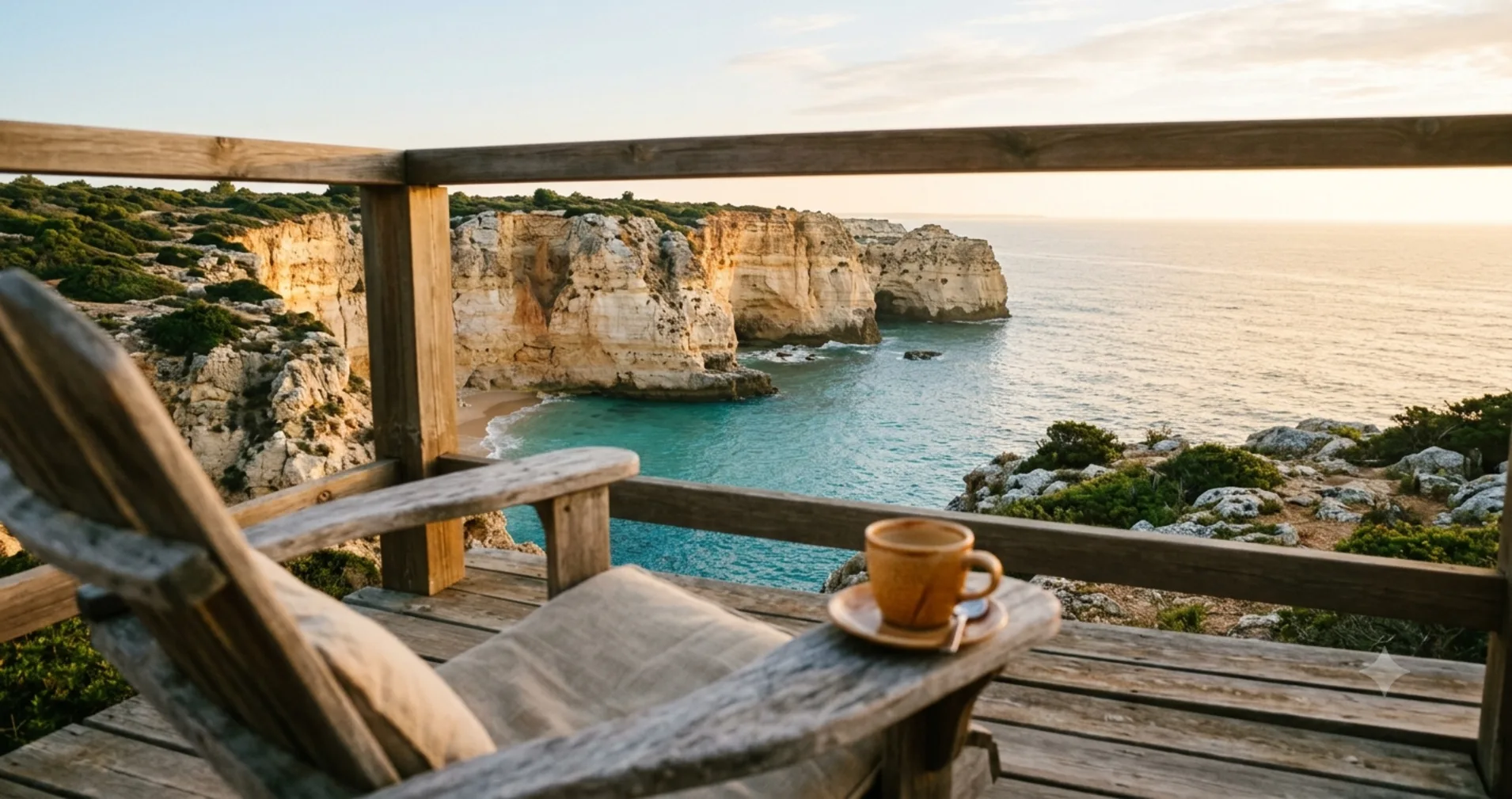
July in the Western Algarve delivers the region's best weather conditions: average daytime highs of approximately 29°C (IPMA Faro normals, 1981–2010), virtually no rain (an average of one to two rain days per month), sea temperatures of approximately 21°C on the south coast, and close to 11 hours of sunshine daily. The month rewards guests who move early (beach before 9:30am, midday retreat to pool or shade), choose beaches one step outside the tourist circuit (Porto de Mós and Camilo over Dona Ana), book restaurants in advance or eat on the Portuguese rhythm (before 7pm or after 9:30pm), and use the long, warm evenings — sunset close to 9pm — for dinner and exploring. For contrast within the same trip, Sagres and the Costa Vicentina are 40–50 minutes from Lagos: dramatically cooler, near-empty beaches in the same month.
Key Takeaways
- •Moving early is the single highest-return strategy in July: arriving at south-facing beaches before 9:30am secures a completely different experience — shade, parking, calm water — compared to arriving after 10:30am, when the most popular spots in Lagos and Alvor become genuinely crowded
- •The Western Algarve has a beach hierarchy in July: famous and crowded (Praia Dona Ana, Praia de Alvor), accessible but filtered by difficult access (Porto de Mós, Camilo with its steep staircase descent), and near-empty for those willing to drive slightly further (Arrifana, Monte Clérigo on the Vicentina coast)
- •Restaurant reservations in July are not optional for the 7pm–9:30pm window: any well-reviewed restaurant in Lagos or Alvor fills completely during that period, often by noon the same day; eating before 7pm or after 9:30pm — the Portuguese rhythm — resolves the problem without sacrificing quality
- •July heat in the Algarve averages 29°C (IPMA Faro normals) and is dry — several degrees milder than the Iberian interior thanks to the Atlantic breeze, not a humid tropical climate; properties with a private pool and shaded terrace make midday entirely comfortable
- •Sagres and the Costa Vicentina — 40–50 minutes from Lagos — offer a dramatically different July: a natural park with near-empty beaches, Atlantic water approximately 4–5°C cooler than the south coast, and temperatures noticeably lower due to the prevailing north-westerly wind
July in the Algarve delivers extraordinary conditions — and extraordinary demand — in the same week
July is simultaneously the Algarve's most spectacular and most demanding month. Both qualities come from the same source: it is when the light is highest and most extraordinary, the sea is at its warmest, and every school system in northern Europe has released its families at the same time.
IPMA climatological normals for the Faro station (1981–2010) put July average daytime highs at approximately 29°C, with an average of one to two rain days for the entire month and close to 11 hours of sunshine per day. The heat is dry — the Atlantic keeps the south Algarve coast significantly cooler and less humid than the interior of Portugal or comparable latitudes in the Mediterranean. Sea temperature on the south-facing coast reaches approximately 21°C: genuinely comfortable for extended swimming, with no wetsuit required.
Sunset happens close to 9pm throughout July. The evenings are long, warm, and entirely usable — this is not a region where dinner at 8pm means eating in the dark. The restaurants, the old town of Lagos, the esplanade at Alvor: all of them function at full capacity well into the night.
The crowds are real. The most famous beaches fill by 10am. The best restaurants require reservations by noon. Parking near the cliff beaches in Lagos fills by 9:30am. These are not exaggerations or warnings — they are simply how July works in a place that receives the majority of its annual visitors in an eight-week window. Understanding the pattern removes the problem almost entirely.
The beach hierarchy determines more about your July than any other single decision
Not every beach in the Western Algarve behaves the same in July, and matching where you go to what you want — and when you arrive — is the decision that determines more than any other.
The most famous beaches — Praia Dona Ana and Praia do Camilo in Lagos, Praia de Alvor — are famous for a reason: dramatic limestone cliffs, clear water, extraordinary views. They are also small, and in July they fill. Praia Dona Ana, one of the most photographed coves in the Algarve, fits perhaps two or three hundred people comfortably. By 10:30am on a July weekend, the parking above it is full and the beach itself is at capacity. Arriving at 8:30am, before the sun has fully cleared the cliffs, is a completely different experience — cool, quiet, the water to yourself.
One tier below the famous beaches, and often overlooked, are the beaches with difficult access: Praia do Camilo (a steep staircase descent with no alternative route) and Praia de Porto de Mós (2 km south-west of Lagos centre, accessible by road but with limited parking). The access is a natural crowd filter. Camilo holds perhaps 50 people; its size alone keeps it quieter than beaches twice its popularity. Porto de Mós has rock formations and far less cliff-side photography traffic than Dona Ana.
For near-empty beaches in the same month, the answer is a forty to fifty minute drive: the Costa Vicentina, a protected natural park that runs north from Sagres along the Atlantic-facing coast, operates on a completely different scale. Arrifana — dramatic cliffs, a working fishing port, a restaurant that serves the catch of the morning — functions as a different kind of beach experience. Praia da Amoreira (a river mouth, broad dunes) and Monte Clérigo (backed by rolling hills) are rarely full in July, with Atlantic water running approximately 16–17°C: cold for long swims, ideal for surfers and for the guests who want drama without crowds.
The simplest rule: south-facing beaches peak between 11am and 5pm. Arriving before 9:30am or after 5:30pm changes the experience entirely, even at the most popular spots.
Dining in July works on a simple principle: eat before 7pm or after 9:30pm
The window between 7pm and 9:30pm at any well-reviewed restaurant in Lagos or Alvor fills completely in July, often by noon the same day. This is not a failure of planning; it is simply peak season operating at full capacity.
Two adjustments resolve it without sacrificing anything. The first: eat before 7pm. Restaurants in the Algarve open early for dinner — some from 6pm — and the kitchen is at its calmest in the first hour. The terrace is less full. Service is less stretched. The food is identical. The tourist penalty for arriving at 7:30pm without a reservation is almost entirely self-imposed.
The second: eat at 9:30pm or later. This is the Portuguese rhythm for dinner, and it works particularly well in July precisely because the long evenings make it feel natural rather than late. The restaurants are still excellent; the crowd has thinned; there is no sense of rushing.
For self-catering or lunch, the Mercado Municipal in Lagos — a covered market with a fish hall on the ground floor — operates until mid-afternoon and runs on a completely different logic from the evening restaurant scene. The fish is priced at what fish costs, not at what July in the Algarve charges. A morning at the market with a well-equipped kitchen removes the dinner calculation from several evenings entirely.
Tascas (small, typically family-run restaurants) on streets one block removed from the main pedestrian circuits of Lagos old town almost always have tables in July. They are not hidden; they are simply not on the routes that tourists walk by default.
July heat in the Algarve averages 29°C and is dry — a pool converts the midday hours completely
The common misunderstanding about July heat in the Algarve is the comparison point. The Atlantic coast of southern Portugal is not the Mediterranean, and it is not the Alentejo interior. The Nortada — a consistent north-westerly sea breeze that sets in by midday — keeps the south Algarve coast significantly more comfortable than the temperature reading suggests.
IPMA normals put July humidity for the Faro coastal station well below what a typical summer day in London or Amsterdam feels like at 22°C. The 29°C is dry. It does not accumulate in the way that humid heat does. Standing in the shade at midday is comfortable; the shade is genuinely cool rather than merely slightly less hot.
The practical rhythm of a July stay in the Algarve structures itself naturally around this: beach before 10am (the best light, the coolest water, the emptiest sand), pool or shaded terrace from midday to 4:30pm, back to the beach or town in the late afternoon when the shadows lengthen and the heat has peaked and begun to release. This is not a constraint imposed by the weather; it is the rhythm that the region itself is designed for, the one that residents and repeat guests follow without thinking about it.
Properties with a private pool change the equation decisively. The middle of a July day in the Algarve is not something to endure or escape — it is the most comfortable part, for guests who have access to water, shade, and a kitchen. The beach-pool-beach-dinner pattern is what July is for.
Day trips from the Western Algarve add dimension to the same journey without adding crowds
Within ninety minutes of Lagos, the landscape changes completely in several directions, each offering a different relationship to July.
Sagres, forty minutes south-west, sits at the south-westernmost point of continental Europe and behaves as though it exists in a different season. The prevailing wind off the Atlantic is consistent and strong; temperatures run noticeably cooler than Lagos even on the same July day. The Fortaleza de Sagres, the Cabo de São Vicente lighthouse, the cliff paths above the Atlantic: none of these are crowded in the same way as the south coast beaches. The town has a working fish market and restaurants that serve what the boats brought in that morning.
North of Sagres, the Costa Vicentina natural park runs along the Atlantic coast towards Aljezur and beyond. This is some of the most protected coastline in Europe — development is severely restricted, which means the beaches (Arrifana, Monte Clérigo, Praia da Amoreira) remain on a scale that is difficult to find elsewhere on the southern Iberian coast in July. The Atlantic water is cold by south-coast standards (approximately 16–17°C), but the beaches themselves are extraordinary.
In the other direction, Tavira — ninety minutes east along the A22 — is the most architecturally preserved Portuguese town in the Algarve, built on both banks of the Gilão River with Roman bridges and Moorish arches still intact. The island beaches (Ilha de Tavira, Ilha de Cabanas) are accessible by ferry from the quay and run on a different logic from the cliff beaches of the west: long, flat, backed by dunes, with the open Atlantic on one side and the calm Ria Formosa on the other.
Forty-five minutes in the opposite direction, the Spanish border at Vila Real de Santo António opens into Andalusia. Ayamonte — the first town across — holds a Tuesday market, a tapas culture, and prices that adjust downward noticeably from the Portuguese summer peak. The rhythm is different; the afternoon is later; the food is Spanish rather than Portuguese. For guests based in the western Algarve, it functions as a full day in a different country without requiring an airport.
How a well-designed property changes the July equation
The difference between a difficult July in the Algarve and a remarkable one often comes down to where you sleep and what the property is designed for.
At LusiberiaStays, the three properties are positioned specifically for the summer pattern. Blue Heaven in Lagos is walking distance from both Praia Dona Ana and Praia de Porto de Mós — the choice between the famous beach and the quieter one, at any time of day, without needing a car. Alvorada sits in Alvor, a village that holds a different rhythm from Lagos in July: the beaches are wider, the old town is quieter, and the Alvor estuary natural reserve starts at the edge of the village. Sun Villa, in the Esuri development near Ayamonte, has direct access to the Spanish Atlantic coast and to Ayamonte itself, with a private pool and a terrace that makes the midday hours the best of the day rather than the hardest.
All three properties have fully equipped kitchens: for market mornings in Lagos, for the guests who prefer to have dinner ready when the beach day ends rather than competing for a table at 8pm. The self-catering option is not a compromise in July — it is frequently the better choice.
July in the Algarve rewards preparation. It also rewards, more simply, knowing how the place works. The guests who come back in August, and the ones who come back the following July, are not the ones who avoided the crowds — they are the ones who learned to work with them, and found the hours and the beaches and the streets where July in the Algarve is exactly what it should be.
The July worth staying for
The Algarve at 8:30am in July, before the main beaches fill, is one of the best things southern Europe offers in summer. The sea at 21°C. The long evenings. The markets still running on a pre-tourist logic. The tapas in Ayamonte on a Tuesday afternoon.
None of these require avoiding July. They require understanding it: moving early, choosing beaches with intention, booking one table in advance, and having the right base for the middle of the day. The guests who find July difficult in the Algarve are, almost without exception, the ones who arrived without a plan and tried to navigate peak season on improvisation. The ones who find it remarkable are the ones who came prepared.
That preparation is what this guide is for.