The Hidden Economics of a 30-Night Stay
TL;DR
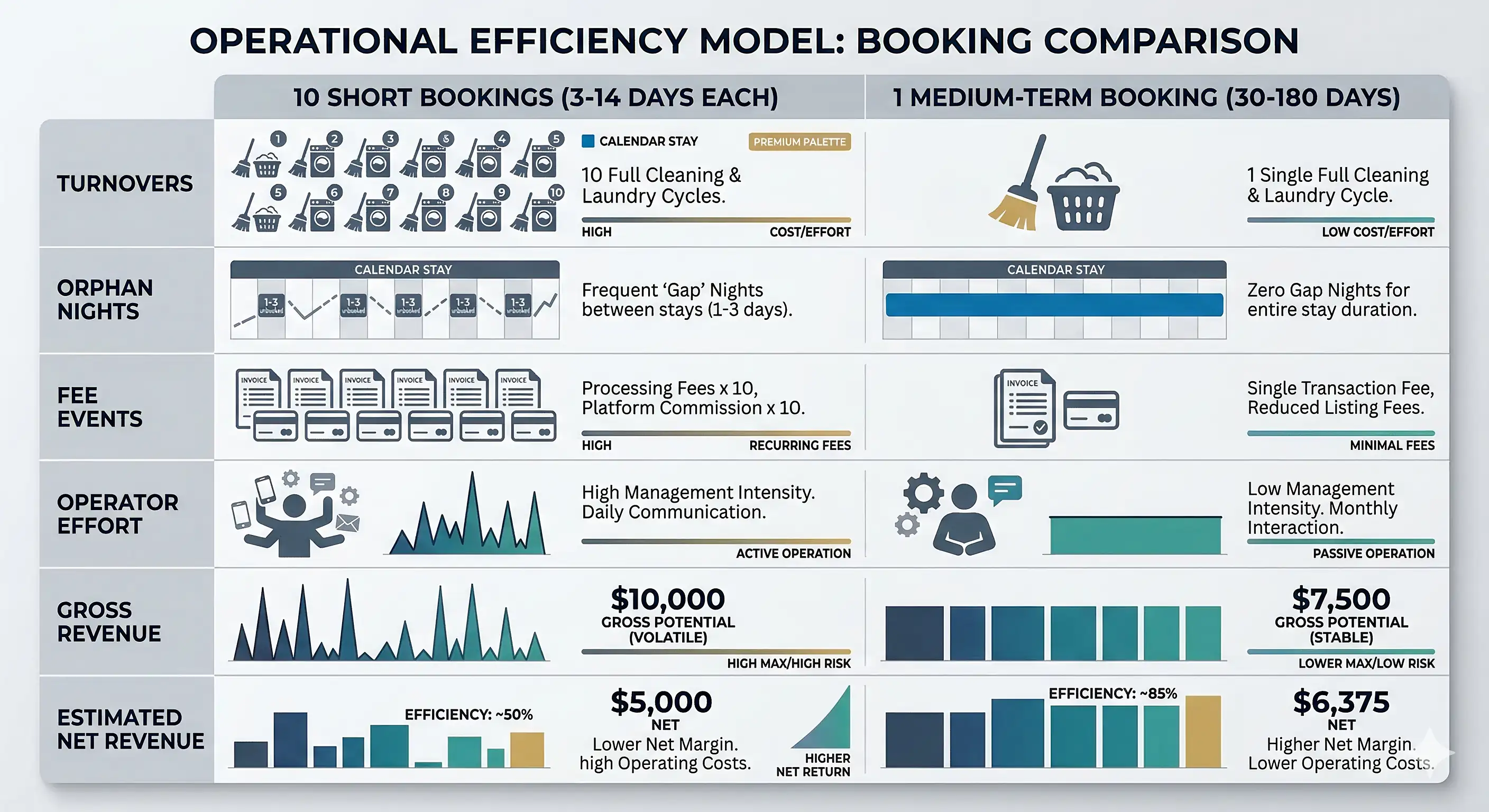
A single 30-night booking in a 2-bedroom property can eliminate roughly €700–€1,100 in cumulative turnover costs in a ten-booking month, significantly reduces operator coordination time, avoids multiple orphan nights worth hundreds of euros in lost revenue, and reduces platform fee exposure by consolidating commission events into one. In markets like Lagos (ADR $196 per AirROI, across 3,543 active listings) and Ayamonte (ADR $158, 29% occupancy per AirROI), the net profit of a medium-term stay frequently matches or exceeds a month of short bookings — even at a 25–35% nightly rate discount. The economics are not intuitive, but they are consistent: the most expensive part of a short stay is not what the guest pays. It is what the operator absorbs.
Key Takeaways
- •Each guest turnover costs €70–€110 for a 2-bedroom property and €90–€170 for a 3-bedroom villa, covering cleaning, linen, laundry, and consumables — costs that multiply with every short booking
- •A month of short-stay bookings requires an order of magnitude more operator coordination than a single 30-night booking covering the same calendar
- •Short stays generate 1–2 night gaps (orphan nights) between bookings that are structurally unbookable — each gap represents lost revenue at ADR levels of $158–$196 in the Algarve and Andalusia
- •Platform commissions of 15–15.5% (Airbnb) or 15% (Booking.com) are applied to each booking including cleaning fees — consolidating into one booking reduces total commission paid
- •A 30-night stay at a 30% discount often produces equal or higher net profit than ten 3-night stays at full rate, once turnover costs, platform fees, orphan nights, and operator time are subtracted
The Number That Does Not Appear on Any Invoice
Every property operator knows their nightly rate. Most know their occupancy. Very few can tell you their actual cost per guest changeover — the total expense incurred every time one guest leaves and another arrives.
This number does not appear on any invoice because it is not a single charge. It is the sum of cleaning labour, linen handling, laundry, consumable restocking, platform commissions on those fees, operator coordination time, and the revenue lost to unbookable gaps between bookings. In a 2-bedroom Algarve apartment, that sum ranges from €70 to €110 per turnover. In a 3-bedroom villa, it reaches €90 to €170.
Multiply that by ten turnovers in a month — the reality of a calendar filled with 3-night stays — and the hidden operating cost of short bookings becomes visible. A single 30-night stay eliminates nine of those turnovers entirely. The question is not whether medium-term stays are discounted. The question is whether short stays are as profitable as they appear.
What a Turnover Actually Costs
A guest turnover is not just a cleaning event. It is a sequence of coordinated operations, each with a measurable cost.
Professional turnover cleaning in the Algarve and Andalusia costs €55–€95 for a 2-bedroom apartment and €90–€150 or more for a 3-bedroom villa. These ranges are derived from cross-referencing Spanish vacation rental operator data — where Kwico and Polaroo report turnover cleaning in the €45–€95 range as an Iberian operating proxy — with Portuguese cleaning labour benchmarks of approximately €10–€15 per hour reported by The Portugal News citing Fixando platform data for 2026.
On top of the clean, each turnover involves linen and laundry handling plus consumable restocking. Based on our operating experience in the Algarve and Andalusia, these additional costs typically add €25–€45 per turnover for a 2-bed property — covering fresh bed and bath linen, laundry service, and basics such as coffee, toiletries, and kitchen supplies.
The total: approximately €70–€110 per turnover for a 2-bedroom apartment, and €90–€170 for a 3-bedroom villa. These are not occasional costs. They are incurred every time a guest checks out. Ten short bookings in a month means ten turnovers. One 30-night booking means one.
The Time That Disappears
Operator time is the most underpriced resource in property management. Based on internal operating experience, each booking generates a materially higher coordination load than its share of occupied nights would suggest — guest communication, vetting, check-in coordination, cleaner scheduling, mid-stay troubleshooting, and checkout management all recur with every reservation regardless of length.
In our experience managing properties across Lagos, Alvor, and Ayamonte, a month of short-stay bookings requires an order of magnitude more active coordination than a single medium-term booking covering the same calendar. This operational overhead is rarely quantified because most operators do not invoice themselves. But it has a real cost: every hour spent coordinating a short-stay turnover is an hour not spent on property improvement, guest experience, or securing the next booking. In a portfolio of multiple properties, this time compounds rapidly.
Orphan Nights: The Revenue That Vanishes
Orphan nights are one of the most consistent and least discussed sources of revenue loss in short-term rental operations. They are the 1- or 2-night gaps that appear between bookings — too short to fill if the property enforces a minimum stay, too short to attract quality guests even if it does not.
PriceLabs' 2026 Portugal market analysis explicitly recommends minimum stays of 6–7 nights during peak season to reduce orphan night exposure — confirming that the issue is operationally significant in the Portuguese vacation rental market.
The Lagos market already shows meaningful adoption of this approach. According to AirROI (February 2025–January 2026 data), 45.3% of Lagos listings require stays of 30 nights or more, while 28.2% sit in the 4–6 night band and only 13.9% allow 1–2 night bookings. The prevalence of longer minimum stays suggests that many operators in this market are actively managing the trade-off between occupancy flexibility and turnover costs.
Each orphan night is a night of zero revenue with ongoing fixed costs — mortgage, insurance, utilities, platform subscription. In Lagos, with ADR of $196 (AirROI), a single orphan night represents a meaningful loss in gross revenue. In Ayamonte, at ADR of approximately $158 (AirROI), the impact is comparable. Over a month, even two or three orphan nights can erode the apparent revenue advantage of short stays.
A 30-night booking eliminates orphan nights by definition. The calendar has no gaps because there are no transitions.
Platform Fees: The Compound Effect
Airbnb currently charges many professional European hosts using host-only pricing approximately 15–15.5% per booking, following the platform's phased migration to 15.5% for PMS-connected hosts in late 2025. Booking.com charges a standard commission of approximately 15%, with Preferred Partner and Genius programmes pushing effective costs to 18–20% or more, according to Your.Rentals. These commissions apply to the total booking value — including cleaning fees.
This creates a compounding effect on short stays. When a guest pays a €70 cleaning fee on a 3-night booking, the platform takes approximately 15% of that fee — roughly €10.50 — in addition to its commission on the nightly rate. Over ten bookings, the platform collects approximately €105 in commission on cleaning fees alone. Over one 30-night booking, it collects €10.50.
Payment processing costs are typically embedded within these platform commission structures rather than charged separately. But the principle remains: more bookings mean more fee events, and the cumulative effect favours fewer, longer stays.
The Scenario: November in Lagos
Consider a 2-bedroom apartment in Lagos during November — a shoulder-season month where medium-term bookings are both realistic and strategic. AirROI reports ADR of $196 for Lagos (approximately €180 at current exchange rates). For a shoulder-season month, a conservative working ADR of €150 is realistic — below the annual figure but above the January low.
Nightly rate€150 (shoulder-season rate)€105 (30% discount) Bookable nights27 (3 orphan nights)30 (no gaps) Gross revenue€4,050 (27 × €150)€3,150 (30 × €105) Turnover costs−€900 (10 × €90)−€90 (1 × €90) Platform commission (15.5%)−€736 (on €4,050 + 10 × €70 cleaning)−€499 (on €3,150 + €70 cleaning) Operator timeSignificantly higherMinimal Estimated net revenue~€2,414~€2,561The 30-night stay produces approximately €147 more in net revenue — while requiring a fraction of the operator coordination. The nightly rate is 30% lower. The net profit is higher. And this scenario assumes the short-stay calendar loses only three nights to gaps — a conservative assumption for a shoulder-season month when demand is thinner and orphan nights are more frequent.
Why Utilities Tell the Same Story
Monthly utility costs for an apartment in Portugal — electricity, water, gas, and internet — average approximately €128 for basic utilities plus €34 for internet, according to Global Citizen Solutions, with a practical range of roughly €120–€265 depending on property size, location, and season. These costs are largely fixed: the property consumes energy whether occupied or not, and the base load (internet, standby appliances, refrigeration) runs continuously.
Short-stay guests tend to use properties more intensively per occupied night than medium-term residents. They are less likely to manage air conditioning conservatively, and the higher turnover frequency generates more laundry cycles. Medium-term guests develop routines that align more closely with residential behaviour — they learn the property's systems and adjust accordingly. Operator experience in the Spanish and Portuguese coastal markets suggests that electricity is the dominant utility component — making cooling behaviour a significant operational variable, particularly during the warmer months.
At LusiberiaStays, all utilities — water, electricity, gas, and high-speed internet — are included in the nightly rate across all three properties: Blue Heaven in Lagos, Alvorada in Alvor, and Sun Villa in Costa Esuri, Ayamonte. This means the total cost is transparent from the moment of booking. For medium-term guests, this transparency is particularly valuable: there are no surprises, no metered charges, no variable costs to estimate.
What the Market Data Confirms
The market structure and cost logic consistently favour medium-term stays in shoulder and low seasons. This is reflected in the operating metrics of the markets where LusiberiaStays operates.
In Lagos, AirROI reports ADR of $196 with 51.5% occupancy across 3,543 active listings (February 2025–January 2026), and year-over-year revenue growth of 11.7%. Peak-season occupancy reaches approximately 78% in August, but drops to around 28.5% in January. The revenue gap between peak and low season underlines the value of medium-term bookings during shoulder and winter months, when short stays are harder to fill and orphan nights are more frequent.
In Ayamonte, AirROI reports ADR of approximately $158 with 29% occupancy in its 2025 market view, though top-tier properties (top 10%) achieve 62% or higher occupancy and top-25% properties reach 40% or more. The lower average occupancy in this market makes medium-term bookings particularly impactful: they fill calendar blocks that would otherwise remain empty, converting zero-revenue nights into guaranteed income.
Across both markets, properties that anchor their calendars with 30-night bookings during shoulder and low seasons can achieve more predictable revenue, lower operating costs per occupied night, and stronger net margins than properties relying exclusively on short-stay turnover.
The Arithmetic Is Clear
The nightly rate is the number most guests and most property owners focus on. It is the most visible metric and the easiest to compare. But it is not the metric that determines profitability.
Net revenue per available night — after turnovers, commissions, orphan nights, and operator time — tells a different story. A 30-night stay at a 25–35% discount consistently produces net margins that match or exceed a calendar of short stays, particularly during shoulder and low seasons when short-stay demand is thinner and gaps are more likely.
This is not an argument against short stays. Peak-season short bookings in July and August, when occupancy exceeds 70% and ADR peaks, remain the highest-revenue calendar configuration in the Algarve. But for the remaining 8–9 months of the year, the economics favour medium-term commitments.
The guest who books 30 nights is not paying less. They are paying the rate that reflects the actual cost of serving them. The guest who books 3 nights is paying more per night — but the operator is absorbing more cost per night to make that stay possible. The difference is invisible on a rate card. It is obvious on a profit and loss statement.
Frequently Asked Questions
Sources & References
- AirROI — Lagos STR Market Data
- AirROI — Ayamonte Market Data
- PriceLabs — Portugal Vacation Rental Market 2026
- PriceLabs — Portugal Vacation Rental Market 2025
- Kwico — Real Cost of Maintaining a Holiday Home in Spain
- Polaroo — Vacation Rental Profitability in Spain 2024-2025
- The Portugal News / Fixando — Cleaning Service Demand in Portugal
- Hostaway — Airbnb Host-Only Fee: What to Know
- Hostaway — Airbnb New Fee Structure
- Your.Rentals — Booking.com Fees for Hosts
- Global Citizen Solutions — Utilities in Portugal
- Resort Rentals Algarve — Holiday Rentals in Lagos 2026 Market Outlook
- NerdWallet — Weekly Airbnb Discount Analysis
- Airbnb — Setting a Price for Longer Stays