What Winter Actually Looks Like in the Western Algarve
TL;DR
Winter in the Western Algarve is genuinely mild, not merely "less cold": IPMA normals put January afternoons at 16°C, roughly double a London or Paris midwinter day, and December — not January or February — is the wettest month of the season. Essential services stay open everywhere; what closes is mostly beach-specific dining, not the region itself. The beaches are at their largest and emptiest, sea temperatures around 15°C keep serious swimming rare, and golf courses drop green fees by 35-44% at major operators outside their real high season of spring and October. January occupancy across LusiberiaStays properties runs at 28.5% against 78% in August, with rates €104–113 versus peak — the clearest evidence that winter here is a different guest, not a discounted summer.
Key Takeaways
- •January afternoons in the western Algarve average 16°C (IPMA Faro normals, 1981-2010) — roughly double a London or Paris midwinter day, and warm enough for lunch on a terrace most days
- •December, not January or February, is the wettest month of the winter — deep winter is actually the driest stretch of the season, with January and February seeing roughly half the rainfall of December
- •What closes in winter is mostly beach-specific dining and kiosks — supermarkets, pharmacies, town-centre restaurants, marinas, and walking trails stay open year-round
- •Golf in the Algarve is genuinely cheaper in winter — green fees drop 35-44% at major operators — but the real high season is spring and October, not December-January; winter golf is a value play, not a peak
- •Winter occupancy across LusiberiaStays properties runs at 28.5% in January versus 78% in August, with rates €104-113 — real evidence this is a different guest, not a discounted summer
The weather, honestly
IPMA climatological normals for the Faro station (1981–2010) put winter daytime highs between 16°C and 20°C: November averages 19.6°C, December 17.0°C, January 16.1°C — the coolest month — and February 16.9°C. Overnight lows sit between 8°C and 12°C, cool enough for a jacket after dark but rarely uncomfortable during the day.
For context, January afternoons in the western Algarve run roughly double a typical London (8.4°C) or Paris (7.6°C) midwinter day. That comparison does more work than any adjective: this is not a cold-weather destination pretending otherwise, it is a genuinely mild one.
The rain pattern holds a detail most guides miss. December is the wettest month of the winter season, with 115.8mm of rainfall across 8.6 rain days on average. January and February are markedly drier — 59.7mm and 52.0mm respectively, roughly half of December's total. Deep winter, in other words, is the driest stretch of the season, not the wettest. A trip planned for early January or February has better odds of consistent dry weather than one planned for mid-December.
What's actually open (and what actually closes)
The idea that the Algarve closes in winter confuses beach bars with the region. Supermarkets, pharmacies, banks, and town-centre restaurants in Lagos, Alvor, and Ayamonte operate on their normal year-round schedule. The Mercado Municipal in Lagos runs its usual hours. Marinas function normally. What genuinely closes, or cuts back to weekends only, is beach-specific dining and kiosks that depend on summer foot traffic — restaurants directly on the sand rather than in town. Even here the pattern varies by establishment rather than being universal, so it is worth checking specific places rather than assuming a blanket closure.
Coastal walking trails — the Ecovia do Litoral, the paths through the Costa Vicentina natural park — stay open year-round and are noticeably quieter and more pleasant to walk in winter, without the midsummer heat.
The beaches in winter
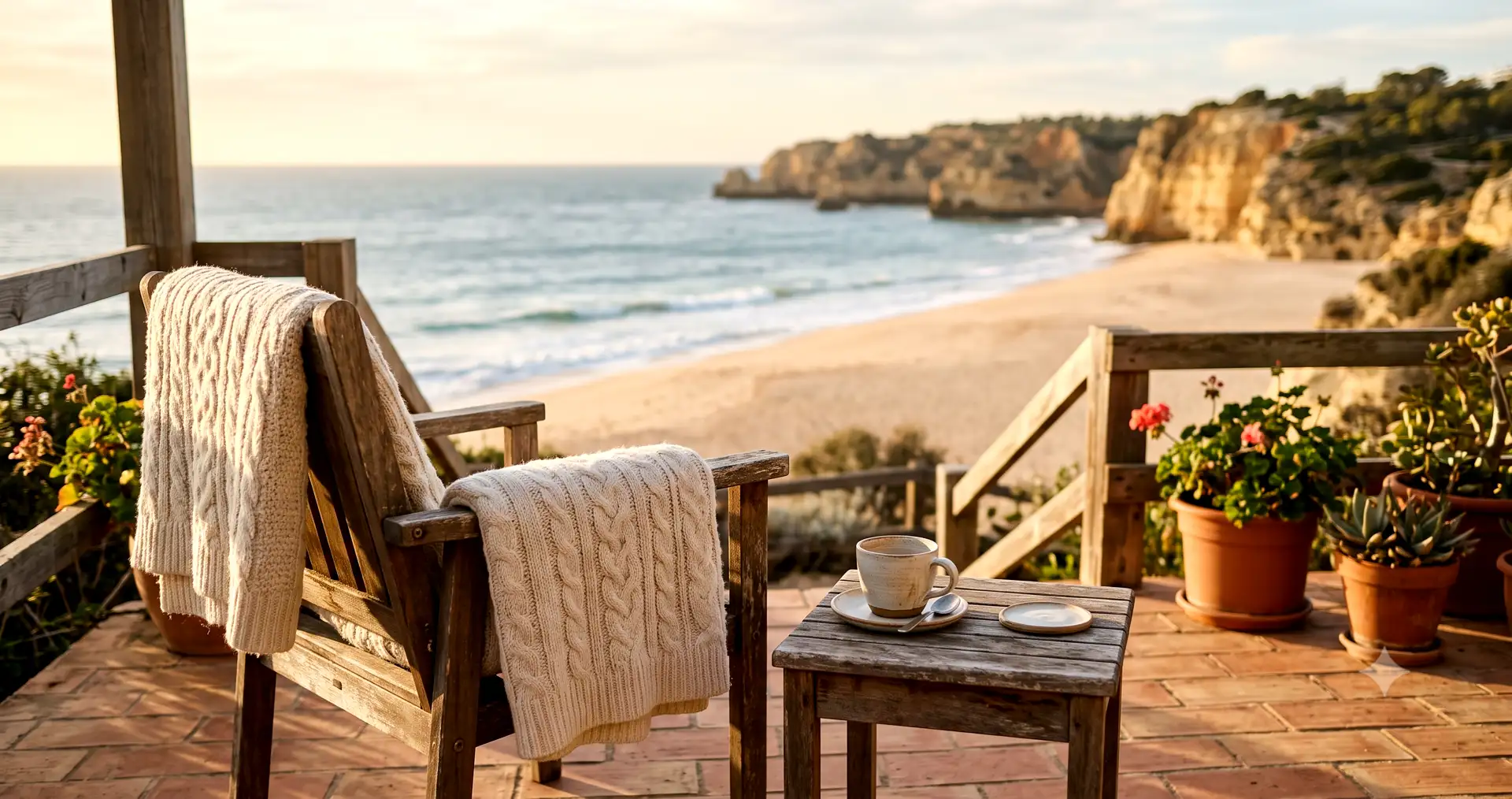
This is the most photogenic argument for a winter visit: the beaches are at their largest and emptiest. Praia Dona Ana, Praia do Camilo, Meia Praia — spots that fill to capacity by mid-morning in July hold a handful of people in January, with low winter light that photographs better than the flat overhead sun of August.
Sea temperature on the south coast runs approximately 15–16°C through winter, coldest in January. That is swimmable for a brief, brisk dip, but too cold for extended swimming for most visitors. The honest framing: winter beaches are for walking, for the light, for having the sand to yourself — not for a long swim. Guests who want warm sea should plan for a different season; guests who want the western Algarve's coastline at its most dramatic and least crowded should come now.
Who winter is actually for
Winter here draws a genuinely different guest, not a smaller version of the summer one. Long-stay visitors — remote workers, retirees spending a month rather than a week, northern Europeans escaping their own winter entirely — make up a meaningfully larger share of winter bookings than summer ones. Walkers and cyclists find the coastal trails at their best, without summer heat or crowds. Golfers find a genuine value proposition: green fees run 35-44% below their spring and October peak at major operators, though it is worth being precise that winter is not the Algarve's golf high season — that distinction belongs to spring (particularly May) and October. Winter golf here is about value, not about playing in the region's most popular months.
Winter suits this profile less well: anyone who specifically wants a lively beach-town atmosphere with every kiosk and bar open, or who needs consistently warm sea swimming as part of the trip. Both are legitimate reasons to visit in a different season, and no honest guide should pretend otherwise.
The occupancy data backs this up plainly. Across LusiberiaStays properties, January occupancy runs at approximately 28.5%, against roughly 78% in August. Low-season nightly rates run €104–113, well below peak. The gap is not a sign that winter is undesirable — it is evidence that a different, smaller, more specific group of travellers already knows to come.
Christmas, New Year, and the January reset
December in the Algarve splits into two distinct halves. From late November through 6 January, the region runs genuinely festive events. Lagos hosts "Natal em Lagos" centred on Praça do Infante — market stalls, an ice rink, a sledging area, a Santa's house, craft workshops, and a handmade nativity scene on display at the Cultural Centre until 10 January. Portimão runs "A Christmas Dream" along the Arade riverfront, with its own ice rink, Christmas market, life-size nativity scene at Largo da Mó, and a festive train.
Once the decorations come down after 6 January, the quietest weeks of the entire year follow. This is deep winter in the fullest sense: empty beaches, dry weather (per the rain data above), and a region that has fully reverted to its residents. For guests who want both — a festive fortnight followed by genuine quiet — a stay that spans the transition captures the Algarve's winter at its most complete.
How LusiberiaStays sets up for winter
All three properties are heated throughout for exactly this season. Sun Villa runs a central HVAC system with a wall thermostat set to heat mode; Blue Heaven and Alvorada each have split-unit air conditioning in every main room, with heating mode available in all units. None of the three requires a guest to choose between a warm home and an authentic winter stay.
The properties are also set up for the guest profile winter actually attracts: fully equipped kitchens for long stays and self-catering, reliable Wi-Fi for remote work, and a pre-arrival message calibrated to the season — flagging which nearby restaurants are open on a given week rather than assuming summer hours.
The season worth understanding, not avoiding
None of this requires choosing winter over summer, or pretending one season is objectively better. It requires knowing, before booking, what November through February actually delivers: real mild weather with real data behind it, a shorter list of open beach restaurants rather than a closed region, a sea too cold for most swimmers but beaches at their most dramatic, and golf and rates at genuine value rather than at their most popular. Guests who arrive with that understanding get exactly what winter here is — not a discounted summer, a different season entirely, on its own terms.