Can You Swim in the Algarve in October? Water, Lifeguards and Light
TL;DR
You can swim in the Algarve in October. Aggregator tables put the sea at roughly 19–21 °C (we found no official beach-level climatology), Faro's mean daily maximum is 23.3 °C and Sagres's 22.4 °C, and Faro averages seven October days reaching 25 °C (IPMA, 1991–2020). Three things change compared with September. The 2026 bathing season listed for every beach in Lagos, Portimão and Vila Real de Santo António ends on 30 September; Albufeira is the only Algarve municipality whose listed season runs into October, until the 15th (Portaria 204-A/2026/1). Rain returns: 56 mm over six days with at least 1 mm at Faro, and in October 2025 the airport recorded 66 of its 69 mm on a single day. And sunset in Lagos moves from 19:19 on 1 October to 17:39 on the 31st, with the clock change on the 25th. Our reading: plan early October around the beach, and late October around mild weather with swims on calm days.
Key Takeaways
- •The sea off the Algarve in October is roughly 19–21 °C on the aggregator tables we could find (Climate-Data.org, accessed September 2026, reference period undisclosed): monthly averages of 19.7 °C at Lagos, 19.9 at Portimão, 20.5 at Tavira and 20.6 at Vila Real de Santo António. We found no official beach-level climatology, so treat these as a range, not a promise.
- •The air figures are official: Faro's October mean daily maximum is 23.3 °C and Sagres's 22.4 °C, Faro averages 7.2 days reaching 25 °C against 3.9 at Sagres, and mean minima are 15.8 °C and 15.0 °C (IPMA climate normals, 1991–2020).
- •The date that matters is 30 September. The 2026 bathing season listed for every beach in Lagos (Batata, Camilo, Dona Ana, Luz, Meia Praia, Porto de Mós), Portimão (including Alvor) and Vila Real de Santo António ends that day. Albufeira is the only Algarve municipality whose listed season runs into October, to the 15th; any supervision elsewhere after 30 September needs local confirmation.
- •Rainfall at Faro rises from 21.5 mm in September to 56 mm in October, spread over six days with at least 1 mm; December is Faro's wettest month and November is Sagres's (IPMA, 1991–2020). October 2025 showed how uneven that can be: 66 of the airport's 69 mm fell on the 29th, after a heatwave from the 9th to the 18th.
- •Sunset in Lagos is at 19:19 on 1 October 2026 and 17:39 on 31 October, with the clocks going back on Sunday the 25th — an hour and forty minutes earlier on the clock inside one month.
- •Our reading of the two halves of October: book the first around the beach; treat the second as a mild-weather stay with swims on calm days, and when there is swell, choose a sheltered cove over an exposed western beach.
The Short Answer, and the Three Things It Leaves Out
Yes, you can swim in the Algarve in October — the figures behind that, and the dates that change what "yes" means
You can swim in the Algarve in October. The aggregator tables we could find put the sea at roughly 19–21 °C, Faro's October mean daily maximum is 23.3 °C and Sagres's 22.4 °C, and Faro averages seven October days reaching 25 °C. The air figures are the official IPMA climate normals for 1991–2020; the sea figures are estimates from weather aggregators, and we will come back to why that distinction matters.
The question people type into a search engine — can you swim in the Algarve in October — hides three others that decide whether an October week works: who is watching the water, how the rain arrives, and how much daylight is left at the end of the afternoon. The sources answer the first two with dates and averages, and the third to the minute; what they cannot tell you is which days of your particular week will be beach days.
The Water: What Can Be Sourced, and What Cannot
Where the 19–21 °C comes from, and how far the east is warmer than the west
We found no official October sea-temperature climatology for the Algarve coast at beach level. The IPMA normals used here report air temperature and rainfall; the Instituto Hidrográfico's Faro buoy has a reference climatology, but publishes it only in its marine-heatwave reports; and the Copernicus Marine satellite record is a gridded dataset from which we have not extracted local values. What is public are aggregator tables built on satellite and buoy data. The one we used, Climate-Data.org (accessed September 2026; reference period undisclosed), gives October monthly averages of 19.7 °C at Lagos, 19.6 at Sagres, 19.9 at Portimão, 20.5 at Tavira and 20.6 at Vila Real de Santo António, with monthly ranges of about 19 to 21.5 °C. September is 0.4 to 1.1 °C warmer at each location; November is 1.6 to 2.1 °C cooler.
Two things stand out in that one table, and both should be read with its limits in mind: the eastern Algarve is about a degree warmer than the west in October, and each location's October range spans one to two degrees, from the warm start of the month to the cool end. We have not verified why the east is warmer, and other aggregators give Lagos anywhere between 19 and 21 °C for the month, so the range is the honest figure.
What 20 °C feels like is personal. It is warm by Atlantic standards, and in our experience most guests swim for ten or twenty minutes without complaint in early October, while children and anyone who feels the cold want the towel and the sun waiting on the sand. Whether a thin wetsuit is worth packing for longer swims late in the month is a choice we leave to the swimmer.
Lifeguards: 30 September Is the Date That Matters
The bathing season is set by law, beach by beach, and in 2026 almost all of it ends before October begins
Portugal's bathing waters and their seasons are fixed each spring by government ordinance. For 2026, Portaria n.º 204-A/2026/1 lists the season as 1 June to 30 September for all six bathing beaches in Lagos — Batata, Camilo, Dona Ana, Luz, Meia Praia and Porto de Mós — for all eight in Portimão, including Alvor Nascente and Poente, Praia da Rocha and Vau, and for the five in Vila Real de Santo António, including Monte Gordo and Manta Rota. The same dates apply in Lagoa, Silves, Vila do Bispo, Aljezur, Loulé, Faro, Olhão and Tavira.
One municipality's listed season runs into October. Albufeira's 26 beaches run from 15 May to 15 October. If a supervised beach is a condition of your booking — with small children, say, or a swimmer who is not confident — Albufeira is the only Algarve municipality whose listed season covers any of October, and only the first half.
Elsewhere, the listed season ends on 30 September and the ordinance does not require supervision after that. It does allow a municipality to add lifeguard cover later, so a beach may still be watched — but that needs confirming locally for your dates, and we have not verified staffing beach by beach. Portimão reported that its 15 lifeguard towers stay installed until 6 October; the installation dates say nothing about staffing. Beach concessions — bars, sunbeds, toilets — fall under a separate rule: for concession purposes the ordinance defines the 2026 national season as 15 April to 31 October, so a given apoio de praia may be open in October, and whether it is depends on the operator. In practice, an October swim in Lagos or Alvor is a swim at your own judgement: pick a calm day, stay inside your depth, and check the IPMA sea-state forecast before choosing the beach.
Rain: 56 Millimetres, and How They Tend to Arrive
The October normal, and one recent month that shows how unevenly it can fall
Rainfall rises in October, and "rises" needs a number. Faro averages 56 mm over six days with at least 1 mm in October, against 21.5 mm in September; November brings 75.5 mm and December, Faro's wettest month, 90 mm (IPMA, 1991–2020). At Sagres the October figure is 61.4 mm and November is the wettest month. On those averages a seven-day stay would see one or two days with rain, but a monthly mean cannot say how many your week will have, nor promise that the second half is wetter than the first.
What the averages hide is how the rain falls. October 2025 is a documented example, because IPMA's monthly bulletin describes it: an anticyclone over the British Isles from the 9th to the 18th produced a heatwave with easterly winds; fronts arrived from the 19th; and Faro airport recorded 65.9 of its 68.8 mm on 29 October alone. That October's mean maximum was 25.3 °C and its mean minimum 17.7 °C, both above the 1991–2020 normal. One month proves no rule, but the normals point the same way: Faro averages only 2.0 October days with 10 mm or more, and 0.6 with 20 mm or more, so when it rains, a fair share of the month's total tends to come at once.
Light and Temperature: What Changes Inside the Month
Lagos sunset times at the start and end of October 2026, and when the nights turn
Daylight is the variable most guides leave out, and in October it changes fast. Sunset in Lagos is at 19:19 on 1 October 2026. By 24 October it is 18:47. The clocks go back on Sunday 25 October, and that evening the sun sets at about 17:46; on the 31st it is 17:39 (our calculation, checked against published tables). An hour and forty minutes earlier on the clock inside one month: in the last week, a beach afternoon that starts after lunch is over by five.
Temperature changes more slowly. Faro's mean daily minimum is 15.8 °C in October; it drops below 12 °C in November (11.9 °C) and below 10 °C in December (9.7 °C), while the mean maximum falls from 23.3 to 19.6 °C between October and November (IPMA, 1991–2020). Colder nights do occur — the lowest October minimum in the 1991–2020 series at Faro was 7.8 °C, on 28 October 1993 — but a typical October evening outdoors needs a light layer, not a coat. One figure worth correcting while we are here: the Algarve coast does not have the warmest October afternoons in Portugal. Inland Alentejo stations do — Amareleja and Alcácer do Sal average 24.9 °C and Mértola 24.2 °C, against Faro's 23.3 °C — while Faro's nights, at 15.8 °C, are milder than any of theirs (Amareleja 12.2, Alcácer 11.9, Beja 13.2; IPMA, 1991–2020). For a beach week, the mild nights are the more useful half of that comparison.
West, Centre or East: Choosing the Stretch of Coast
What the figures show about location, and what we add from living here
The Algarve's ends behave differently in October, and part of that is in the figures. The western tip — Sagres, Vila do Bispo, the Costa Vicentina — is cooler by day (22.4 °C at Sagres against 23.3 °C at Faro) and the water is at the cool end of the table (19.6 °C). The rest is local experience: this is the coast most exposed to wind and the first to feel the autumn swell, which makes it the surfers' choice in October and, from an unsupervised beach, the least forgiving place for a casual swim.
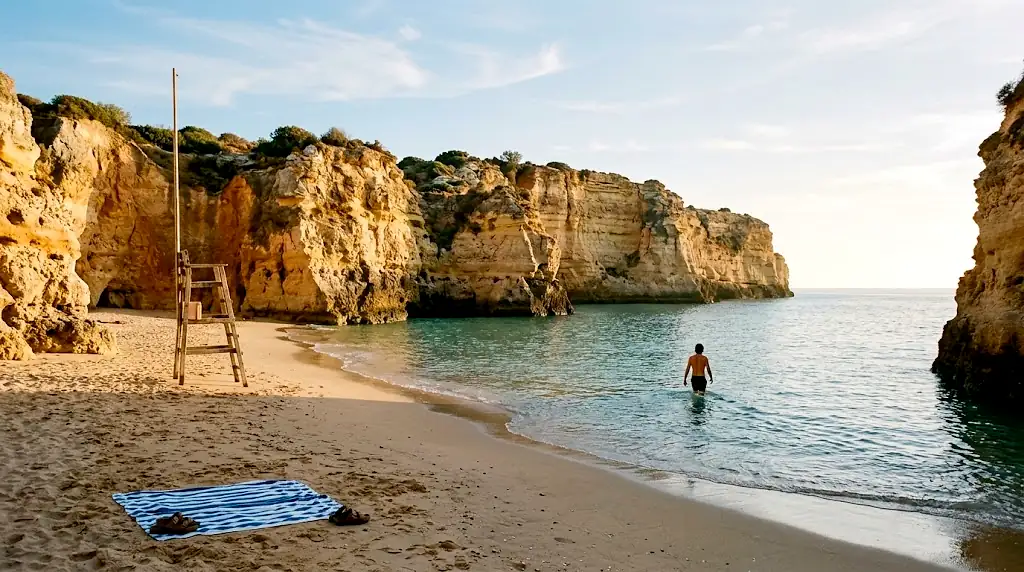
Lagos and Alvor, in the centre-west, are where we are based, and what follows is what we see rather than what a dataset shows. The Lagos coves — Dona Ana, Camilo, Batata — sit inside limestone cliffs and are usually calm on days when the open beaches are not. Alvor's long beach faces the open Atlantic, but the estuary side behind the sandbar is flat on most days. When the sea-state forecast shows swell, that is where we would send a guest who still wants to swim.
The eastern Algarve — Monte Gordo, Manta Rota, the barrier islands off Tavira — has the warmest October water on the aggregator table (20.5 to 20.6 °C) and, in our experience, the flattest sea on the coast, with long, gently shelving beaches. Like everywhere except Albufeira, its listed season ends on 30 September. On the Spanish side of the Guadiana, at Isla Canela and Punta del Moral, the Portuguese ordinance does not apply, and we have not checked the Spanish arrangements.
How to Read October Before You Book
The same figures, turned into planning advice for a stay at Blue Heaven or Alvorada
Our reading is that October divides in two, and the figures above are why: the water loses a degree or two, the rain rises, and the clock takes an hour and forty minutes off the evening. We would book the first half of the month around the beach, accepting that supervision has ended, and treat the second half as a mild-weather stay in which a swim is a bonus on calm days. That is a planning heuristic drawn from averages, not a boundary the data draws.
Two checks make the difference between the average and your actual week. In the days before travelling, look at the IPMA ten-day forecast for Lagos or Portimão, which will show whether a front is due; and once here, look at the IPMA sea-state forecast before choosing between an open beach and a cove. For guests at Blue Heaven in Lagos, the coves below the town are the calm-water option; for Alvorada in Alvor, it is the estuary side of the beach. We are happy to point either way on the day.
The rule we apply to this article is the one we try to apply to every seasonal recommendation: a figure goes in with its source and year beside it, and where we only found estimates — as with the sea temperature — we say so instead of rounding an estimate into a fact. A monthly average cannot describe the sequence of weather during your stay; it can tell you what to check, and when.
What to Take From This
October is a swimming month in the Algarve for anyone who accepts three conditions: water around 20 °C on the tables available, no listed supervision outside Albufeira after 30 September, and an evening that ends before six by the last week. In return, Faro averages seven days reaching 25 °C, six days with rain in the whole month, and, in our experience, the beaches have a fraction of August's people. Our advice: book early October for the sea, late October for the weather, and let the sea-state forecast — not the calendar — choose the beach.
Frequently Asked Questions
Sources & References
- IPMA — Normal Climatológica Faro 1991–2020 (estação 554, v1.0, 2024)
- IPMA — Normal Climatológica Sagres 1991–2020 (estação 533)
- IPMA — Normal Climatológica Beja 1991–2020 (estação 562)
- IPMA — Normal Climatológica Sines 1991–2020 (estação 541)
- IPMA — Boletim Climático Portugal Continental, Outubro 2025
- Diário da República — Portaria n.º 204-A/2026/1, de 30 de abril (épocas balneares 2026)
- Agência Portuguesa do Ambiente — Época balnear 2026
- Câmara Municipal de Portimão via Barlavento — Portimão inicia época balnear com reforço da segurança nas praias (torres 25/05–06/10)
- timeanddate.com — Sunrise and sunset times in Lagos, October 2026 (cross-checked against a NOAA solar-position calculation)
- IPMA — Normal Climatológica Amareleja 1991–2020
- IPMA — Normal Climatológica Alcácer do Sal 1991–2020
- IPMA — Normal Climatológica Mértola 1991–2020
- Climate-Data.org — Lagos water temperature by month (aggregator; reference period undisclosed; accessed 2026-09-11)
- Climate-Data.org — Portimão water temperature by month (accessed 2026-09-11)
- Climate-Data.org — Sagres water temperature by month (accessed 2026-09-11)
- Climate-Data.org — Tavira water temperature by month (accessed 2026-09-11)
- Climate-Data.org — Vila Real de Santo António water temperature by month (accessed 2026-09-11)
- Instituto Hidrográfico — Faro Costeira buoy marine-heatwave report (reference climatology Copernicus 1984–2024; no monthly means published)