Which Is the Prettiest Town in the Algarve?
TL;DR
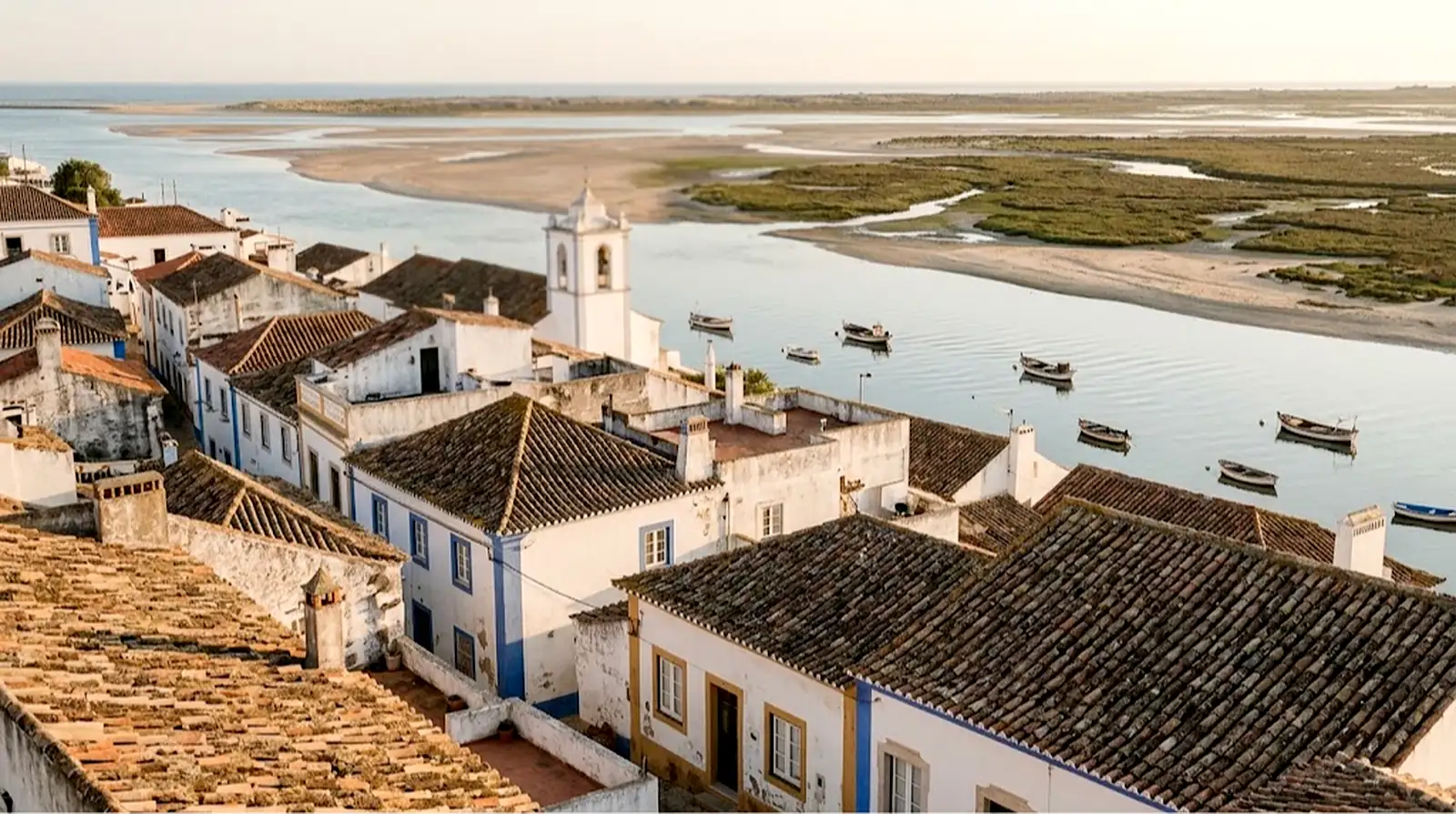
Our pick for the prettiest town in the Algarve is Tavira: a historic centre inside walls classified as a National Monument, a river running through the middle and the Ria Formosa Natural Park at its edge. If a village will do, Cacela Velha is the purer answer: the whole village is a classified heritage ensemble on a hill above the Ria Formosa, one of only two Algarve settlements whose historic core is protected as a whole at national level. Lagos ties with Tavira on the records and suits anyone who wants the sea at the end of the street; Silves has one of the best-preserved Islamic castles in Portugal; Ferragudo and Alvor are smaller places where the water matters more than the monuments. We have houses in Lagos and Alvor, and say so wherever it is relevant.
Key Takeaways
- •Tavira is our pick for a town: castle walls classified as a Monumento Nacional in 1939 and extended in 2014, the Gilão river through the centre, and the Ria Formosa Natural Park reaching the area just south of the city.
- •Cacela Velha is classified as a whole, as an Imóvel de Interesse Público since 1996; with the Pombaline centre of Vila Real de Santo António, it is one of only two Algarve historic cores protected in their entirety at national level.
- •On the heritage record alone Lagos and Tavira are level: Lagos's walls have been a National Monument since 1924 and became the first fully bastioned town wall in Portugal in the sixteenth century.
- •Silves castle, a National Monument since 1910, is described by the register as one of the most important and best-preserved Islamic fortifications in Portugal.
- •Ferragudo and Alvor carry smaller classifications but sit on protected or open water: Alvor on the Ria de Alvor, a Natura 2000 site of 1,454 hectares since 2000, and Ferragudo on the mouth of the Arade.
The Short Answer
Tavira is our pick for a town; Cacela Velha is our pick if a village will do
Tavira is the Algarve town we would send someone to if beauty were the only brief: a historic centre inside walls classified as a National Monument, a river through the middle, and the Ria Formosa lagoon at its edge. If the word "town" can stretch to a village, Cacela Velha is the purer answer, because there the village itself is the monument.
"Prettiest" is a judgement, not a measurement, and no table can settle it. What can be checked is which places carry the credentials that usually travel with that judgement: what the national heritage register protects, whether the historic core survives, and whether water is in view. That is how the six places below were compared, on the same terms. We have houses in Lagos and Alvor; neither is our first answer, and both are described with the same evidence as the rest.
How We Compared Them
We used four public criteria and no score
Each place was checked against the same four things: what the national heritage register, Património Cultural, classifies in the part of town you actually walk; whether the historic core is recognised as such; whether water is in view from it, and whether that water is protected; and the scale of the place. Every classification, date and decree below comes from the register's own entries, read in October 2026.
The method has a bias worth stating: heritage registers favour old, large, fortified towns. A fishing village with no listed building can be lovely and score nothing. So the records support the answer here rather than decide it. Blue Flags, monument counts and population figures were left out, because they measure other things.
Checking against the register mattered. A research summary produced by an AI assistant, which we ran alongside our own reading, gave the wrong classification for three of the seven monuments we checked, including the date of Tavira's walls. Every classification in this article links to the register entry it came from.
Tavira: A River Town Inside Its Walls
Tavira combines classified walls, a river through the centre and the Ria Formosa at its edge
Tavira's castle walls are a Monumento Nacional, classified in 1939; in 2014 the classification was extended to sections of wall left out the first time. The register describes a late Islamic town that grew quickly in importance in the twelfth century and, by the late Middle Ages, a walled perimeter of about five hectares. King Manuel I raised Tavira to the status of city in March 1520.
What sets Tavira apart from the other walled towns is the river. The Gilão runs through the town rather than past it, and the town spreads along both banks. South of the city the land runs into the Ria Formosa Natural Park, the protected lagoon system of the eastern Algarve; the government resolution that revised the park's plan in 2001 deals specifically with the zone immediately south of Tavira, next to the urban area.
Two things the guides repeat need a correction. The old bridge over the Gilão is usually called Roman. The register, which classifies it as an Imóvel de Interesse Público, says plainly that the bridge you cross is not Roman: it is a seventeenth-century reconstruction, finished in 1657 to a design by the architect Mateus do Couto, that removed almost all of its earlier features, although a Roman first crossing on the site is likely. And Tavira's famous "37 churches" is a number nobody has pinned down: a historian quoted it in 1987 while saying he had not checked it, and the municipality's own booklets have counted 34 in the whole municipality and 21 in the town, depending on what counts as a church.
Tavira is also a working town, with a railway station on the Linha do Algarve ten minutes' walk from Praça da República. That makes it a place to stay for several days rather than only to visit, and that, more than any single monument, is why it is our first answer.
Cacela Velha: The Village That Is the Monument
Cacela Velha is one of only two Algarve settlements whose historic core is classified as a whole at national level
Most heritage classifications protect a building. In Cacela Velha the register protects the village: the ensemble was classified as an Imóvel de Interesse Público in 1996, under the typology "historic centre". The register calls it one of the most important heritage ensembles in the Algarve, a humanised landscape coherently preserved at the entrance to the Ria Formosa, gathered on a hill above the lagoon and joined by a narrow arm of water to the barrier island in front.
The only other Algarve settlement with its historic core classified as a whole at national level is the Pombaline centre of Vila Real de Santo António, a planned town the Marquis of Pombal ordered built in 1773 on the site of a fishing village, and classified as a Conjunto de Interesse Público. It is beautiful in a different, geometric way: straight streets and a square laid out on paper before they were built.
Cacela Velha lies inside the Ria Formosa Natural Park. It is a village, not a town, and that is both its strength and its limit. It is a place to visit more than a place to base a week.
Lagos and Silves: Walls by the Sea, and a Castle Above a River
Lagos and Silves both have fortifications classified as National Monuments, and each meets the water differently
Lagos's walls and towers have been a Monumento Nacional since 1924, and Lagos itself has been a city since King Sebastião raised it in January 1573. The register traces a medieval wall enlarged under King Manuel I and then, from 1556 under João III, with particular attention to its western side, given ten more bastions, which made it the first fully bastioned town wall in Portugal. Lagos looks at the sea: the bay, the marina and, a walk away, the cliffs of Ponta da Piedade.
On the records alone, Lagos and Tavira are level, and choosing between them is a matter of taste: a walled town that faces the ocean, or one built along a river. We put Tavira first. We have a house in Lagos, which is a reason to tell you rather than a reason for either choice. How the town works for a stay is in our Lagos or Albufeira guide.
Silves castle has been a Monumento Nacional since 1910. The register calls it one of the main Islamic fortifications in Portugal and one of the best preserved; in the eleventh century, under the poet-king al-Mu'tamid, Silves was the capital of an independent taifa kingdom, and its walls enclosed about twelve hectares. The town climbs a hill above the Arade river, inland. There is no beach, and that is part of its character.
Ferragudo and Alvor: Small and by the Water
Ferragudo and Alvor are smaller places where the water matters more than the monuments
Ferragudo sits on the east bank of the mouth of the Arade, facing Portimão across the river, and has been a vila since 1999. Its castle, São João do Arade, is an Imóvel de Interesse Público, built from the 1640s to guard the river bar and, according to the register, sold at public auction in 1896 and left largely unaltered since. It stands at the river mouth, a short distance from the village itself.
Alvor's castle ruins are an Imóvel de Interesse Público, which the register describes as hidden among the white houses of the village, with stretches of wall still more than five metres high; the main and side portals of the parish church are classified too, though the church as a whole is not. The village faces the Ria de Alvor, a Natura 2000 site of 1,454 hectares since 2000 and a Ramsar wetland. We have a house in Alvor; our essay on Alvor says what we think of it.
Which One Suits Your Visit
The right answer depends less on beauty than on what you want around it
For a historic town to stay in, with a river through it: Tavira. For a walled town with the sea and the cliffs within walking distance: Lagos. For a castle and a day inland: Silves. For a village to walk through in an afternoon, above a lagoon: Cacela Velha. For a planned eighteenth-century grid on the border river: Vila Real de Santo António. For a small riverside place facing a city across the water: Ferragudo. For a flat beach and a protected lagoon: Alvor.
How We Approach Questions Like This
Lists of the prettiest towns tend to compete on adjectives. LusiberiaStays works the other way round: we check the public record first, say where the record runs out and the judgement begins, and declare where we have a commercial interest. The register entries are linked below so that every classification here can be checked in a minute. The opinion, Tavira first, is ours, and it is labelled as such.
What to Take From This
If you want one name, it is Tavira. If you will accept a village, it is Cacela Velha, whose whole centre is protected. If you want the sea at the end of the street, Lagos is level with Tavira on every record we checked. None of these places is far from the others, and the Linha do Algarve links several of them, so the town you choose to stay in does not have to be the only one you see.
Frequently Asked Questions
Sources & References
- Património Cultural — Muralhas do Castelo de Tavira (MN; Dec. 29 604/1939; Dec. 17/2014)
- Património Cultural — Cacela Velha (conjunto) (IIP; Dec. 2/96)
- Património Cultural — Núcleo histórico pombalino de Vila Real de Santo António (CIP)
- Património Cultural — Muralhas e torreões de Lagos (MN; Dec. 9 842/1924)
- Património Cultural — Castelo de Silves (MN; Decreto de 16-06-1910)
- Património Cultural — Castelo de São João de Arade, Ferragudo (IIP; Dec. 735/74)
- Património Cultural — Ruínas do antigo castelo ou Forte de Alvor (IIP; Dec. 29/84)
- Património Cultural — Pórticos principal e lateral da igreja matriz de Alvor (IIP; Dec. 37 077/1948)
- Resolução do Conselho de Ministros n.º 37/2001 — revisão do Plano de Ordenamento do Parque Natural da Ria Formosa (FAOLEX)
- Sítio Rede Natura 2000 Ria de Alvor PTCON0058 (RCM 76/2000; ficha do Plano Sectorial, RCM 115-A/2008), Câmara Municipal de Portimão
- Universidad de Huelva — Cacela-a-Velha no contexto da actividade marítima e do povoamento rural do Sudoeste peninsular, séculos XII–XIV
- Barlavento — 25 anos de vila de Ferragudo celebrados com homenagens a poetas e autarcas
- CP — Comboios Regionais Vila Real de Santo António–Lagos, horário desde 19 de Julho de 2026
- Património Cultural — Ponte antiga sobre o Rio Gilão (IIP; Dec. 1/86)
- Postal do Algarve — Tavira celebra 500 anos de elevação a cidade
- Postal do Algarve — Lagos celebra 449 anos sobre a sua elevação a cidade
- Portugal Resident (Peter Booker) — The Churches of Tavira, Part 1
- Google Maps — walking directions: Tavira station–Praça da República (10 min, 800 m); Lagos station–Praça Gil Eanes (14 min, 1.0 km); Silves station–castle (34 min, 2.3 km); Ferragudo stop–parish church (32 min, 2.2 km); Cacela halt–Cacela Velha church (37 min, 2.7 km)