Easter Week in the Western Algarve — What Actually Changes
TL;DR
Easter week in the Western Algarve — Palm Sunday (March 29) to Easter Sunday (April 5, 2026) — is the first demand peak of the tourist season. The Algarve recorded 76–78% hotel occupancy at Easter 2024, with short-term rental demand spiking in the same window driven by coinciding school holidays in England and Wales (March 30–April 10) and most German states (March 30–April 10/11). IPMA climatological normals for Faro confirm April average highs of 20.4°C with 9–10 hours of daily sunshine; sea temperature approximately 16–17°C. Good Friday (April 3) is a national public holiday in both Portugal and Spain; Maundy Thursday (April 2) is additionally a regional holiday in Andalusia, creating a four-day Easter weekend across the border. Ayamonte (30–45 minutes from the Western Algarve) celebrates Semana Santa declared a Fiesta de Interés Turístico Nacional — the La Madrugá (early hours of Good Friday, led by the Cofradía de Nuestro Padre Jesús Nazareno) is its emotional peak. The week after Easter offers the same conditions at significantly lower rates.
Key Takeaways
- •Easter week 2026 runs from Palm Sunday March 29 to Easter Sunday April 5; Good Friday (April 3) is a national public holiday in Portugal and Spain; Maundy Thursday (April 2) is additionally a regional holiday in Andalusia — a four-day Easter weekend across the border
- •Easter is the first demand peak of the year: the Algarve recorded 76–78% hotel occupancy at Easter 2024 (AHP); good STR properties in Lagos and Alvor are typically fully booked by February
- •IPMA April normals for Faro: average daytime high 20.4°C, 9–10 hours daily sunshine, sea approximately 16–17°C — good for walking and sunbathing, cold for swimming
- •Ayamonte (30–45 min from the Western Algarve) celebrates Semana Santa declared a Fiesta de Interés Turístico Nacional; La Madrugá (early hours of Good Friday, Cofradía de Nuestro Padre Jesús Nazareno) is its emotional peak
- •UK school Easter break: March 30–April 10, 2026; Germany (most states): March 30–April 10/11 — both overlap precisely, driving concentrated northern European family demand
What Easter Week Actually Is Here
The region's rhythm, not the tourist calendar
In northern Europe, Easter means school holidays, family travel, and the first attempt at spring. In the Western Algarve, it means something slightly different: the first real signal that the season has begun.
February and early March in the Algarve are quiet. Occupancy is low, restaurants keep reduced hours, some rental properties are not yet in operation. Then Palm Sunday arrives, and something shifts. Flights fill. Roads have more cars. Restaurants that have been running at half-capacity start requiring reservations. Beaches that have been empty for months see their first sunbathers of the year.
This is not a summer crowd. Easter week in the Western Algarve is busy by February standards and quiet by August standards. The guests who arrive during this week tend to be a specific profile: families with school-age children from the UK, Germany, and the Netherlands; Portuguese and Spanish domestic tourists taking advantage of the bank holidays; and longer-stay guests using Easter week as the opening of a spring season that will stretch into May.
Understanding this profile changes how the week feels. It is not a party week, not a festival week, not a beach week in the summer sense. It is a slow, warm, spring week — with noticeably more people than the month before, and noticeably fewer than the month after.
The Climate Window
What to expect, honestly
Early April in the Western Algarve is one of the more variable times of the year. According to IPMA climatological normals for Faro (1981–2010), the average daytime high in April is 20.4°C, with an average low of 11.7°C. Sunshine averages 9–10 hours per day. April also brings approximately 38.8mm of rain spread across roughly six days — meaning roughly an 80% chance of a dry day on any given date.
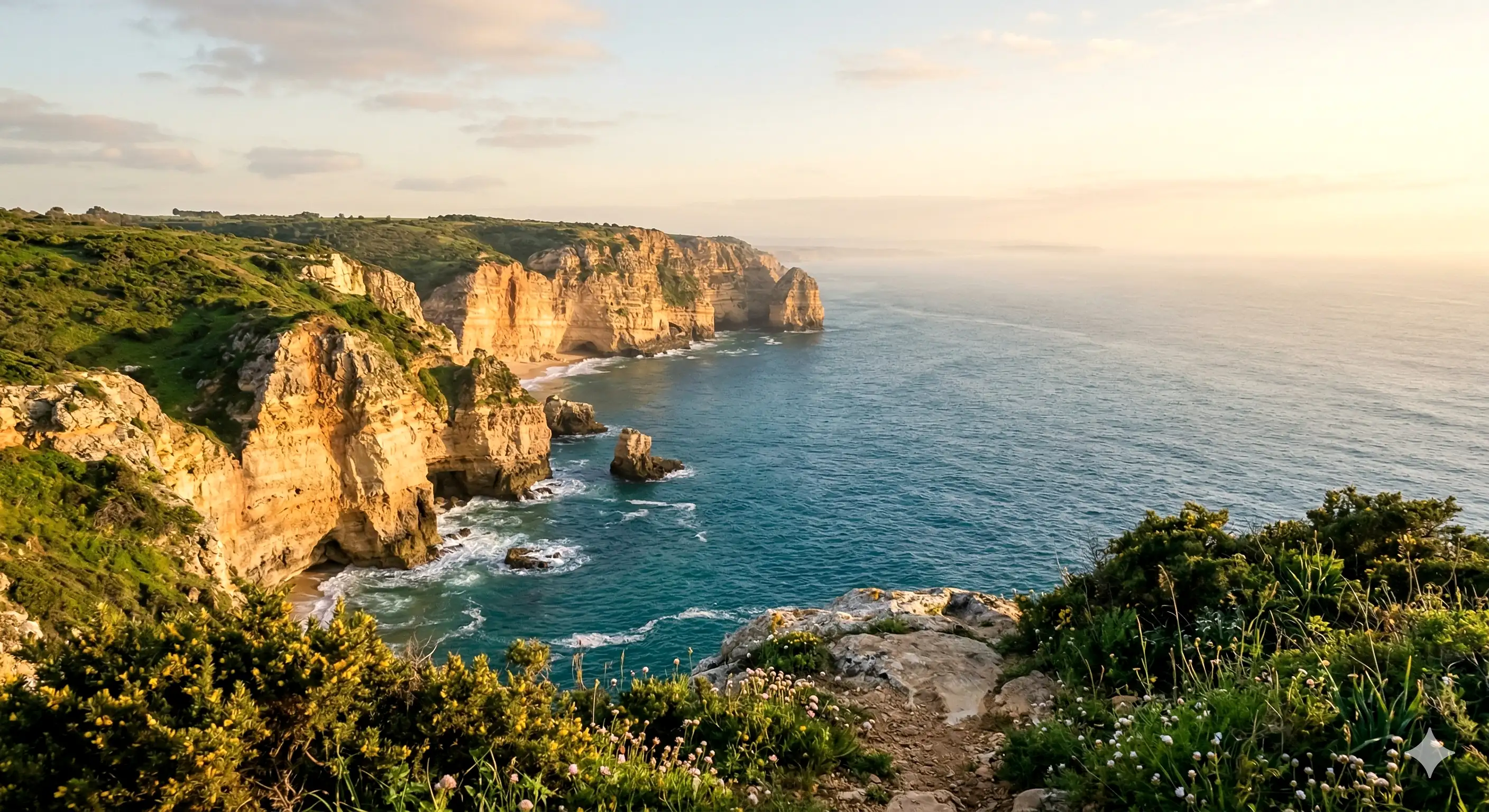
A warm Easter day in Lagos — clear sky, 22°C, light breeze — is genuinely excellent. It is spring Algarve at its most pleasant: good light, green hills, long evenings, no heat stress. The terraces are comfortable all day. The hiking trails above Ponta da Piedade are at their most photogenic.
But April can also deliver a cooler afternoon, a morning of Atlantic cloud, or an occasional rain shower. Easter week should not be booked with the expectation of guaranteed beach days. It should be booked with the expectation of spring Algarve: mostly warm, consistently light, occasionally variable.
The sea temperature at Easter is approximately 16–17°C. That is cold by most standards. Some guests swim — particularly northern Europeans acclimatised to colder water. Most don't. Beaches are used for walking, sunbathing on warmer days, and photography — not for the extended sea time that defines July and August.
For guests whose primary goal is swimming in the sea, May offers warmer conditions. For guests whose primary goal is the landscape, the light, and the atmosphere — without the summer density — Easter is a legitimate and underrated window.
The Crowd Pattern
Who arrives and why
Northern European families. In England and Wales, Easter school holidays run from March 30 to April 10, 2026. In most German states (Bavaria, NRW, Berlin, Baden-Württemberg, Hesse), the Osterferien run from March 30 to April 10 or 11. Both markets are on the same two-week calendar — a concentrated demand window that has filled the Western Algarve at Easter for decades. These guests tend to book entire properties, stay 7–10 nights, and use the rental as a base for day trips rather than staying on the beach.
Portuguese and Spanish domestic tourists. Good Friday is a public holiday in both Portugal and Spain, and Maundy Thursday is an additional regional holiday in Andalusia. Many Portuguese families use the long weekend for a break in the Algarve. Cross-border movement also increases: guests based in Alvor or Lagos will visit Ayamonte for the Semana Santa processions; guests based in Huelva or Seville will cross into Portugal for a quieter Easter break.
Spring-season openers. A smaller but distinct group — often returning guests — who deliberately time their arrival to coincide with Easter as the start of a longer spring stay. These guests typically book 2–4 weeks, overlapping Easter and May, to get the shoulder-season pricing advantage before the summer rates begin.
The pattern matters because it tells you what kind of week Easter actually is: family-oriented, culturally engaged, split between Portugal and Spain, and shaped more by school calendars than by beach season logic.
What Changes, What Doesn't
Good Friday, Semana Santa, and practical reality
Good Friday (April 3) is a public holiday in Portugal and Spain — and Maundy Thursday (April 2) is an additional regional holiday in Andalusia. This creates a four-day Easter weekend across the border in Ayamonte. In practice, many shops and services close or operate reduced hours on the public holidays. Restaurants typically remain open — Good Friday is one of the busiest restaurant days of Easter week, particularly for seafood (bacalhau in Portugal, pescado in Spain). Booking ahead for Friday dinner is strongly advisable.
Ayamonte's Semana Santa is the real thing. Across the border in Ayamonte — 30 minutes from Alvor, 45 minutes from Lagos — the Holy Week celebrations follow full Andalusian tradition and have been declared a Fiesta de Interés Turístico Nacional de Andalucía. Brotherhoods (hermandades) carry floats (pasos) through the streets, accompanied by saeta singing and military bands. The processions run from Palm Sunday through Easter Sunday.
The spiritual peak of the week is the La Madrugá — the early-hours procession of Good Friday, led by the Cofradía de Nuestro Padre Jesús Nazareno. departing at approximately 2:00 AM from the Capilla del Socorro. It carries the weight of the most intense moment in Andalusian Holy Week tradition. For guests staying in the Western Algarve, this is an experience unlike anything in the Portuguese calendar — free, open, and 30 minutes away.
The Western Algarve is calm by comparison. Portuguese Semana Santa is a religious occasion, not a spectacle. Masses are held, there are small local processions in some towns, and Good Friday has a quiet, slow quality. For guests who find Ayamonte's intensity appealing, it is easily accessible. For those who prefer the quieter Portuguese register, the Algarve side delivers that by default.
Accommodation availability tightens sharply. Easter week is the first demand peak of the year. The Algarve recorded 76–78% hotel occupancy at Easter 2024. For short-term rentals, booking platforms report Easter week demand spiking significantly above surrounding weeks as northern European school holidays concentrate into the same window. Well-located family properties tighten noticeably ahead of Easter — earlier booking means better choice. Guests who have not yet secured accommodation in late March will find limited inventory and elevated pricing.
After Easter, availability opens up. Easter is one of the first clear spring demand spikes; the weeks after see noticeably more availability and softer pricing. The crowd disperses and the weather continues to improve. Guests who can shift their dates 7–10 days after Easter often find better conditions with more choice.
The LusiberiaStays View
How this week fits into the broader season
At LusiberiaStays, Easter week occupies a specific position in the seasonal calendar: it is the transition between the quiet winter period and the shoulder season that builds through April and peaks in May–June.
For guests considering Easter week at Blue Heaven in Lagos, Alvorada in Alvor, or Sun Villa in Costa Esuri, the practical guidance is straightforward. The weather is good but variable — pack a layer. The sea is cold — approach it as landscape, not a swimming pool. The region is noticeably livelier than February but still accessible by summer standards. Good Friday has a different atmosphere — quieter, slower, worth leaning into rather than fighting against.
For guests who want the cultural dimension, the proximity to Ayamonte's Semana Santa is a genuine advantage. The border crossing takes 30 minutes. The La Madrugá procession is free, open, and unlike anything in the Western Algarve itself.
For guests who are primarily price-sensitive, the honest advice is to wait one week. The conditions in mid-to-late April are arguably better — the weather has stabilised further, the crowds have dispersed, and the rates reflect neither the Easter premium nor the peak-season pricing of June. It is the best-value spring window in the Algarve.
Easter week is worth booking if the timing works and the cultural dimension is part of the appeal. It is not worth booking for guests whose primary goal is warm sea, beach density, or summer atmosphere. For that, the region asks for patience until June.
Conclusion
Easter week in the Western Algarve is the region's first spring signal — the moment when a quiet winter landscape becomes, briefly, a busy one. Temperatures are good, light is excellent, and the cultural dimension — particularly Ayamonte's La Madrugá — adds something that the summer season does not offer.
But this week is also the year's first demand spike. Prices are elevated, availability is limited, and the conditions — while genuinely pleasant — are not what the Algarve becomes in June. Good Friday closes many services and creates a slower rhythm that is not negative, just different.
Guests who understand this week for what it is — a spring opening, not a summer preview — tend to experience it well. Those who arrive with summer expectations leave slightly disappointed by a sea temperature that will not warm for another two months.
The Western Algarve in Easter week is worth it. Just bring a jacket for the evenings, book your Friday dinner table, and consider crossing to Ayamonte on Thursday night for the Madrugá.