What March to May Actually Looks Like in Southern Iberia
TL;DR
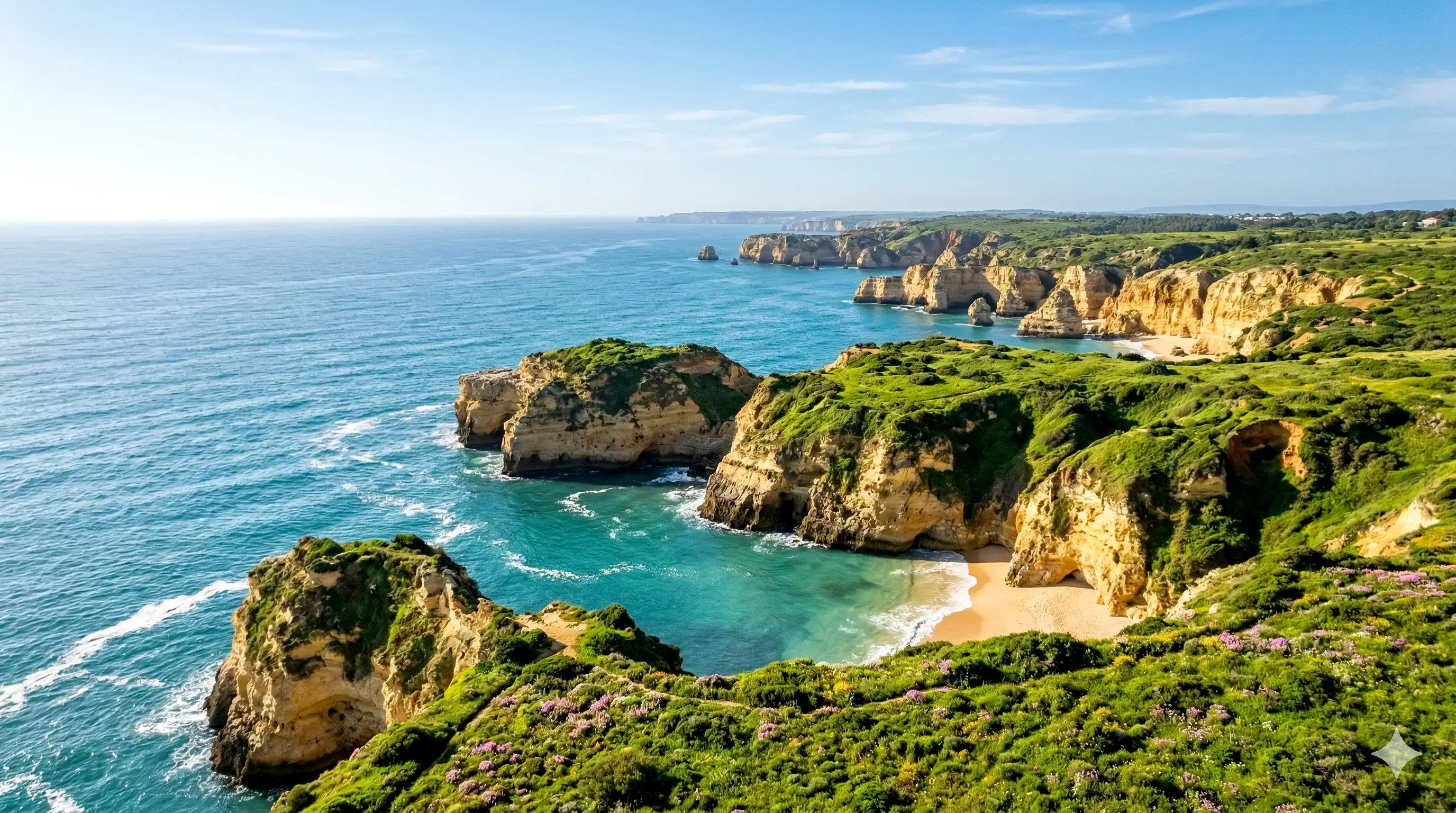
The western Algarve and Costa Esuri between March and May average 19-23C daytime temperatures with 7-10 hours of daily sunshine and fewer than 5 precipitation days per month. Short-term rental rates in Lagos run approximately 113 euros per night in May compared to 153-260 euros in July-August, a 35-78% premium avoided. Faro Airport activates its full summer schedule on March 29, 2026, with Ryanair operating 47 routes. The Rota Vicentina hiking trail is in its best season, golf courses are at peak condition, and the Festival dos Descobrimentos in Lagos runs April 30 to May 4 with over 2,000 costumed performers. Costa Esuri offers rates indicatively 30-40% below the western Algarve with warmer spring temperatures reaching 26C in May.
Key Takeaways
- •Faro IPMA data shows spring daytime highs of 19.0°C in March, 20.4°C in April, and 22.8°C in May, with only 3.7-5.1 precipitation days per month
- •Short-term rental rates in Lagos average approximately €113 per night in May versus €153-260 in July-August, representing a 35-78% peak season premium
- •Faro Airport activates its IATA summer schedule on 29 March 2026, with Ryanair operating 47 routes and 270+ weekly flights
- •The Rota Vicentina trail system spans 226 km and is in its best hiking season from March to early June, with wildflowers, nesting storks, and cooler temperatures
- •The XII Festival dos Descobrimentos in Lagos runs 30 April to 4 May 2026, with the theme 'De Lagos ao Japão' and more than 2,000 costumed performers
- •Costa Esuri and Ayamonte offer spring accommodation rates indicatively 30-40% lower than the western Algarve, with warmer temperatures reaching 26°C in May
The Shoulder Season Window
Spring in southern Iberia is not a transitional afterthought between winter and summer. It is a distinct season with its own climate profile, its own economics, and its own appeal. The three months from March to May represent the shoulder season — the period when weather conditions are already favourable, services are largely operational, but peak-season pricing and crowds have not yet arrived.
The western Algarve (Lagos, Alvor, Portimão) and the Huelva coast (Ayamonte, Costa Esuri) share the same latitude but face different bodies of water. Lagos and Alvor sit on the Atlantic, exposed to oceanic weather patterns. Ayamonte, just across the Guadiana river on the Spanish side, benefits from a more sheltered position and slightly higher temperatures. Both areas receive abundant sunshine — Faro records 3,135 hours per year, among the highest figures in Europe.
The data from IPMA (Portugal's meteorological institute) paints a clear picture of steady warming across the three months.
March 10.5 19.0 19 ~7 4.7 15.3C April 11.7 20.4 22 ~8-9 5.1 16-17C May 14.0 22.8 26 ~9-10 3.7 18C July (comparison) 19.0 29.1 32-34 12 <1 21-22CMarch begins with pleasant daytime temperatures around 19C and cool evenings around 10-11C. By May, daytime highs reach 22-23C in the Algarve and 26C in Ayamonte — warm enough for outdoor dining, beach walks, and full days outside without the oppressive heat that characterises July and August. Rainfall follows a clear decline: the Mediterranean precipitation pattern concentrates rain in the October-March wet season, and by April it drops sharply. May averages just 3.7 days with any measurable rain.
Ayamonte consistently runs warmer than the Algarve coast in spring, with May highs of 26C compared to Faro's 22.8C. This difference reflects the Algarve's greater exposure to Atlantic maritime cooling. For guests who want warm afternoons without the extreme heat of an Andalusian summer, the March-to-May window in Costa Esuri is particularly well calibrated.
What Is Open and What Is Not
Most services across the western Algarve operate year-round, but a few seasonal attractions have specific opening windows that matter for spring visitors.
Beaches and lifeguards. All beaches in Lagos, Alvor, and Ayamonte are fully accessible year-round. Lifeguard coverage at the major Algarve beaches typically begins around May 15, with the official bathing season (época balnear) formally running from June 1 to September 30. In March and April, beaches are open but unguarded. The water is cold — 15-17C — and swimming without a wetsuit is uncommon before late May.
Water parks. Slide and Splash in Lagoa opens from April 1, 2026, through October 31, with some closure days in April and May. Hours begin at 10am-5pm and extend later in summer. Aqualand in Alcantarilha does not open until June 9, 2026 — it is entirely closed throughout the spring shoulder season. Families planning around water parks should check the Slide and Splash calendar in advance and disregard Aqualand until June.
Boat tours. Ponta da Piedade grotto tours from Lagos Marina operate year-round, with full spring frequency. Tours last approximately 75 minutes and cost 15-25 euros. The grottos and sea caves are best experienced from the water, and spring provides calmer morning conditions than the winter months.
Dolphin watching. Common and bottlenose dolphins are resident year-round off the Algarve coast. The best months for sighting frequency and calm seas are April through October. March is possible but conditions can be rougher, and operators may cancel more frequently. Spring also brings migratory species — fin whales and humpbacks pass through in March and April.
Golf. All major Algarve courses operate year-round. Spring is considered the peak golf season — fairways are green from winter rain, temperatures are comfortable for a full round, and courses are not at summer capacity. March through May is when the region hosts the highest density of visiting golfers, particularly from the UK, Germany, and Scandinavia.
Restaurants. Most restaurants in Lagos, Alvor, and Ayamonte operate year-round. Some smaller seasonal beach restaurants that close in November or December reopen in March or April. The dining scene is effectively fully operational from Easter onward.
Supermarkets — a cross-border note. In Portugal, large supermarkets (Continente, Pingo Doce, Lidl, Intermarché) are open seven days a week including Sundays, with no seasonal closures. In Ayamonte, the main Mercadona is typically closed on Sundays outside peak summer — the "Zona de Gran Afluencia Turistica" exception allowing Sunday trading generally applies only in July and August, though this should be verified locally before travelling. Coviran at Costa Esuri opens on Sundays from 10am to 3pm and serves as the practical alternative.
Getting There: Flights and Roads
Faro Airport is the primary gateway to the western Algarve, and its capacity shifts dramatically between winter and summer. The IATA summer schedule activates on March 29, 2026, and with it comes the full network of seasonal routes that define the airport's peak connectivity.
In the 2025 summer schedule, Ryanair operated 47 routes from Faro with over 270 weekly flights, most activating between late March and May. The 2026 schedule adds new routes including Ryanair's Warsaw Modlin service from March 29, additional easyJet capacity, and Jet2 frequency increases. United Airlines runs a Newark-to-Faro route from May to September — Faro's sole transatlantic connection, based on the 2025 precedent. The airport exceeded 10 million passengers in 2025, a 6% increase over 2024 and a record in its history.
The practical implication: flight availability and pricing to Faro improve substantially from late March. By April, the full European route network is operational. Guests arriving from the UK, Germany, the Netherlands, France, and Scandinavia have the broadest set of options between April and October.
Driving in the region. The A22 motorway (Via do Infante) across the Algarve has been toll-free since January 1, 2025, and remains so in 2026. No legislation reversing this has been enacted. This eliminates a cost that previously added approximately 12 euros per east-west crossing and makes the motorway the default route for all Algarve travel.
Car rental. Spring car rental rates from Faro are approximately 150 euros per week for a small car with full coverage. This compares favourably to summer pricing, when rates increase significantly and availability tightens. Spring also means lighter traffic — the EN125 congestion between Lagos and Albufeira that characterises July and August is largely absent, and beach parking is readily available.
The Economics of Staying in Spring
The financial case for spring travel in southern Iberia is unambiguous. Short-term rental pricing follows a predictable seasonal curve, and the shoulder season represents the clearest value in the calendar.
February (low) ~107 euros Lowest -5% May (shoulder) ~113 euros 60-66% Baseline July-August (peak) ~153-260 euros 78-85% +35-78% Annual average ~130-185 euros 51-65% —The gap between May and peak summer is substantial. A two-week stay at 113 euros per night totals approximately 1,582 euros. The same two weeks in August at 200 euros per night would cost 2,800 euros — a difference of over 1,200 euros on accommodation alone. When combined with lower car rental rates, quieter restaurants, and easier logistics, the total cost differential for a spring visit is significant.
Costa Esuri and Ayamonte sit in a different pricing tier. No aggregated public STR data exists for the area (unlike Lagos, which is covered by AirDNA and PriceLabs), but local market patterns suggest rates indicatively 30-40% below the western Algarve — though no public aggregator data exists for Costa Esuri, so this estimate should be treated as directional rather than precise. Costa Esuri is primarily a residential and second-home community with lower Airbnb density, which keeps pricing competitive.
The digital nomad angle. Spring is the high point for remote workers choosing the Algarve as a base. CoLagos, the municipal coworking space in central Lagos, charges approximately 10 euros per day or 100-130 euros per month. The cost of living for a single person in Lagos runs approximately 1,300-1,500 euros per month — 20-40% cheaper than Lisbon. Couples can expect 1,800-2,300 euros per month.
Portugal's D8 Digital Nomad Visa requires a minimum monthly income of 3,680 euros (2026 figure) plus savings of 11,040 euros and proof of Portuguese housing. The NHR tax regime closed to new applicants on January 1, 2024, and its replacement — the IFICI regime — is restricted to scientific research, innovation, and startups, making it inapplicable to general digital nomads. Despite this, the combination of low cost of living, reliable internet, established coworking infrastructure, and pleasant climate continues to attract a steady flow of remote workers to the western Algarve, with the shoulder season being the preferred arrival window.
Nature at Its Best
The natural environment of southern Iberia reaches its annual peak between March and early June. The combination of winter rainfall, warming temperatures, and lengthening days produces conditions that disappear entirely in the dry summer months.
Rota Vicentina. The 226-kilometre trail system along the Vicentine Coast — including the Fisherman's Trail along the cliff edges — is in its best season from March to early June. Spring brings wildflower carpets across the cliff tops, white storks nesting on cliff edges, and hiking temperatures that avoid the heat exhaustion risk of summer. Trail traffic is lighter, wildlife is more active, and the landscape is green rather than the parched brown of August. September to November offers a second good window, but spring is widely considered the prime hiking season.
Birdwatching. The Ria Formosa lagoon system east of Faro hosts over 200 recorded species and receives more than 30,000 migratory birds per year. Spring migration from March through May is the prime birdwatching period: flamingos, spoonbills, black-winged stilts, and avocets are among the signature species. Castro Marim, Portugal's first nature reserve (established 1975), near the Spanish border, adds Audouin's Gull, Little Tern, and Collared Pratincole to the spring migration list. The western Algarve's coastal position on the East Atlantic Flyway makes it one of the most productive birdwatching destinations in southwestern Europe during this window.
Surf. The Algarve's surf season runs broadly from September through April for experienced surfers, with powerful northwest Atlantic swells hitting west-coast breaks like Arrifana and Bordeira. May represents a transition — swell energy decreases, and conditions become more forgiving. For beginners and intermediates, May is the sweet spot. Meia Praia in Lagos, a long sandy beach with gentle breaks, is particularly well suited for learners during this period. Surf schools operate throughout spring.
One important reality check: Atlantic sea temperatures. The water averages 15.3C in March, 16-17C in April, and 18C in May. These figures are 3-5C colder than equivalent Mediterranean latitudes. A 4/3mm wetsuit is non-negotiable for surfing and any extended time in the water from March through May. Casual beach swimming without a wetsuit is rare before late June.
March 15.3C 4/3mm Strong NW swells — advanced April 16-17C 4/3mm Transitional — improving for intermediates May 18C 4/3mm (or 3/2mm for short sessions) Sweet spot for beginners (Meia Praia) July (comparison) 21-22C Optional (shorty or boardshorts) Small, clean — learner-friendlySpring Events Worth Planning Around
The spring cultural calendar in the Algarve is denser than most visitors expect. Several events have regional significance and can influence accommodation availability in their immediate areas.
Easter (April 5, 2026). Holy Week (Semana Santa) runs from March 29 to April 5. Easter is a major domestic travel period in both Portugal and Spain. Accommodation demand increases across the Algarve and Andalusia during this window. Restaurants and attractions are at higher capacity. Alvor and Lagos see an influx of Portuguese families from Lisbon and the north. Ayamonte draws Spanish visitors from Seville and Huelva province. Booking accommodation before February is advisable for Easter week stays.
Festa da Mãe Soberana, Loulé (April 5 and April 19, 2026). One of the Algarve's most important religious processions, honouring Our Lady of Piety. The two dates mark different stages of the celebration. The April 19 procession through Loulé's steep streets is the larger event and draws significant crowds from across the region.
14th Albufeira Wine Fair (April 17-19, 2026). Three days of wine tasting, regional producers, and gastronomy in central Albufeira. The event showcases Algarve wines alongside producers from the Alentejo, Douro, and other Portuguese regions. Accessible from Lagos (approximately 45 minutes via A22) and Alvor (approximately 35 minutes).
XII Festival dos Descobrimentos, Lagos (April 30 - May 4, 2026). The flagship cultural event of the Lagos spring calendar. Now in its 12th edition, the 2026 theme is "De Lagos ao Japão" (From Lagos to Japan), reflecting the historical Portuguese maritime connection to Japan. The five-day festival brings over 2,000 costumed performers to the historic centre. The Quincentist Fair occupies Praça do Infante with period market stalls, artisan demonstrations, and food. Reenactments include caravel construction, cannon fire demonstrations, and dromedary parades. The event transforms Lagos's old town for nearly a week and is the single largest draw for spring visitors to the area.
Festa das Tochas Floridas, São Brás de Alportel (April 5, 2026). An Easter Sunday tradition featuring elaborately decorated flower torches carried through the streets. A quieter, more local event than the Lagos festival, but culturally distinctive and worth the 90-minute drive from Lagos for those interested in Algarve traditions.
The LusiberiaStays Approach
LusiberiaStays operates properties in Lagos, Alvor, and Costa Esuri — three locations that each experience the shoulder season differently. The operational approach adjusts accordingly.
Spring stays tend to be longer than summer bookings. The typical guest profile shifts from week-long family holidays toward two-to-four-week stays by remote workers, retirees, and couples exploring the region at a slower pace. This changes how properties are prepared: fast broadband reliability matters more, kitchen equipment is used more intensively, and local area information takes on greater importance when guests have time to explore beyond the beaches.
Every guest receives a digital guide specific to the property, accessible via a secure portal link with no app download required. The guides are updated seasonally and include practical shoulder-season information: which beaches have lifeguard coverage and when, which seasonal restaurants have reopened, current supermarket hours on both sides of the border, and trail conditions on the Rota Vicentina. For spring stays, the guides include specific notes on water temperature expectations, wetsuit rental locations, and the Festival dos Descobrimentos schedule when applicable.
Property preparation for the shoulder season follows a different rhythm. Heating systems are checked before March bookings — spring evenings at 10-12C require functioning heating, unlike summer. Outdoor furniture and barbecue areas are serviced after winter. Dehumidifiers run during the transition period to ensure properties are dry and comfortable on arrival.
A note for property owners. The shoulder season data carries a different operational message. May occupancy at 60-66% in Lagos represents revenue at a reduced nightly rate but with significantly lower guest turnover, fewer cleaning cycles, and reduced wear. Properties that attract 30-night stays in spring — particularly from remote workers and retirees — generate stable income with minimal operational overhead. The economics of shoulder season occupancy often outperform headline peak-season ADR when net margins are calculated. Combined with the region's favourable spring climate and growing digital nomad infrastructure, the March-to-May window represents an increasingly important segment of the annual rental calendar.
Frequently Asked Questions
Sources & References
- IPMA — Faro climatological normals 1981-2010
- IPMA — Climate normals portal
- AEMET — Ayamonte forecast
- AirROI — Lagos vacation rental data
- AirDNA — Lagos overview
- PriceLabs — Portugal vacation rental market
- ACP — A22 toll-free confirmation
- Observador — A22 toll-free Jan 2025
- Slide & Splash — Opening dates
- Aqualand — Seasonal calendar
- Lagos Boat Tours — Ponta da Piedade
- The Algarve Family — Dolphin watching Lagos
- Ryanair — Faro summer schedule
- Portugal Resident — Faro 10M passengers
- CoLagos — Municipal coworking
- Casas do Barlavento — D8 visa guide
- Rota Vicentina — Fisherman's Trail
- Natura Algarve — Birdwatching Ria Formosa
- Only by Land — Birdwatching Portugal
- Sea Temperature — Algarve
- Igor Swieczak — Algarve surf guide
- CM Lagos — Festival dos Descobrimentos
- Visit Algarve — Festival dos Descobrimentos
- Safe Communities Portugal — Beach safety
- Mercadona Ayamonte — Hours
- Portugal Investment Properties — Cost of living Algarve
- Renting a Car in Europe 101 — Algarve car rental