Where to Eat in Ayamonte — A Local Dining Guide
TL;DR
Sun Villa sits in Costa Esuri, on the edge of Ayamonte — the town centre is 10 to 15 minutes by car. The local kitchen runs on three things: gambas blancas de Huelva (white Atlantic shrimp, among the world's finest), mojama (salt-cured air-dried tuna, the house speciality of every deli in town), and jamón ibérico from the Jabugo sierra inland. Casa Luciano (Calle del Condado 1) is the most established seafood house; El Paladar is the best local tapa stop. Spanish lunch is 13:30–16:30, dinner from 20:30 — plan around it. Vila Real de Santo António is 10 minutes by car or about 15 minutes by ferry.
Planning a stay?
Explore Sun Villa and request a quote for your dates.
View Sun VillaKey Takeaways
- •Guests at Sun Villa (Costa Esuri) are already in Ayamonte — the town centre is 10 to 15 minutes by car. This is one of the best-stocked larders in southern Iberia: gambas blancas, almadraba tuna, mojama, and jamón ibérico de Jabugo are all local products, available fresh in the market and on bar menus every day
- •The three local products worth ordering anywhere in Ayamonte: gambas blancas de Huelva (white Atlantic shrimp, considered among the world's finest), mojama (salt-cured air-dried tuna, the local preserved speciality), and jamón ibérico de Jabugo (the most celebrated cured ham in Spain, from the nearby sierra)
- •Spanish kitchens open for lunch at 13:30 — never before — and for dinner at 20:30. Tourists arriving at 7 PM for dinner will find most restaurants closed or in prep. Plan lunch around 14:00 for the best experience and the fullest kitchen
- •Casa Luciano (Calle del Condado 1) is the most established seafood house in town; La Puerta Ancha (Plaza de la Laguna, 14) offers the most creative cooking; El Paladar is the best option for a quick, cheap, local tapa alongside residents
- •The surrounding area adds depth to the trip: Vila Real de Santo António (15 min by ferry, Restaurante Cuca for fresh fish), Isla Cristina (20 min west along the Huelva coast, major fishing port for mojama and tuna), and Castro Marim/Altura (Portugal, 15–25 min north, A Chamine for cataplana de ouro)
Your Town for This Stay
What Ayamonte is, and why it matters for the table
Costa Esuri sits at the edge of Ayamonte — the last Spanish town before the Guadiana river marks the border with Portugal. This is not a resort strip. It is a real Andalusian town of around 20,000 people that has been fishing these waters for centuries, curing tuna, raising Iberian pigs in the sierra behind it, and eating in a way that has not been significantly altered by tourism.
There are no Michelin stars in the province of Huelva. There is no gastronomy press circuit, no influencer footprint. What Ayamonte has instead is exceptional raw material — and a local population that knows how to use it. During your stay, this is your kitchen.
Three Things Worth Knowing Before You Order
The products that make Ayamonte different
The first is gambas blancas de Huelva. White Atlantic shrimp from the stretch of sea between the Guadalquivir and Guadiana rivers are considered among the finest shellfish in the world — a claim that holds up on the plate. They are smaller and more delicate than the pink shrimp you may know from elsewhere, with a sweetness that disappears if overcooked. Order them boiled or à la plancha; that is all they need.
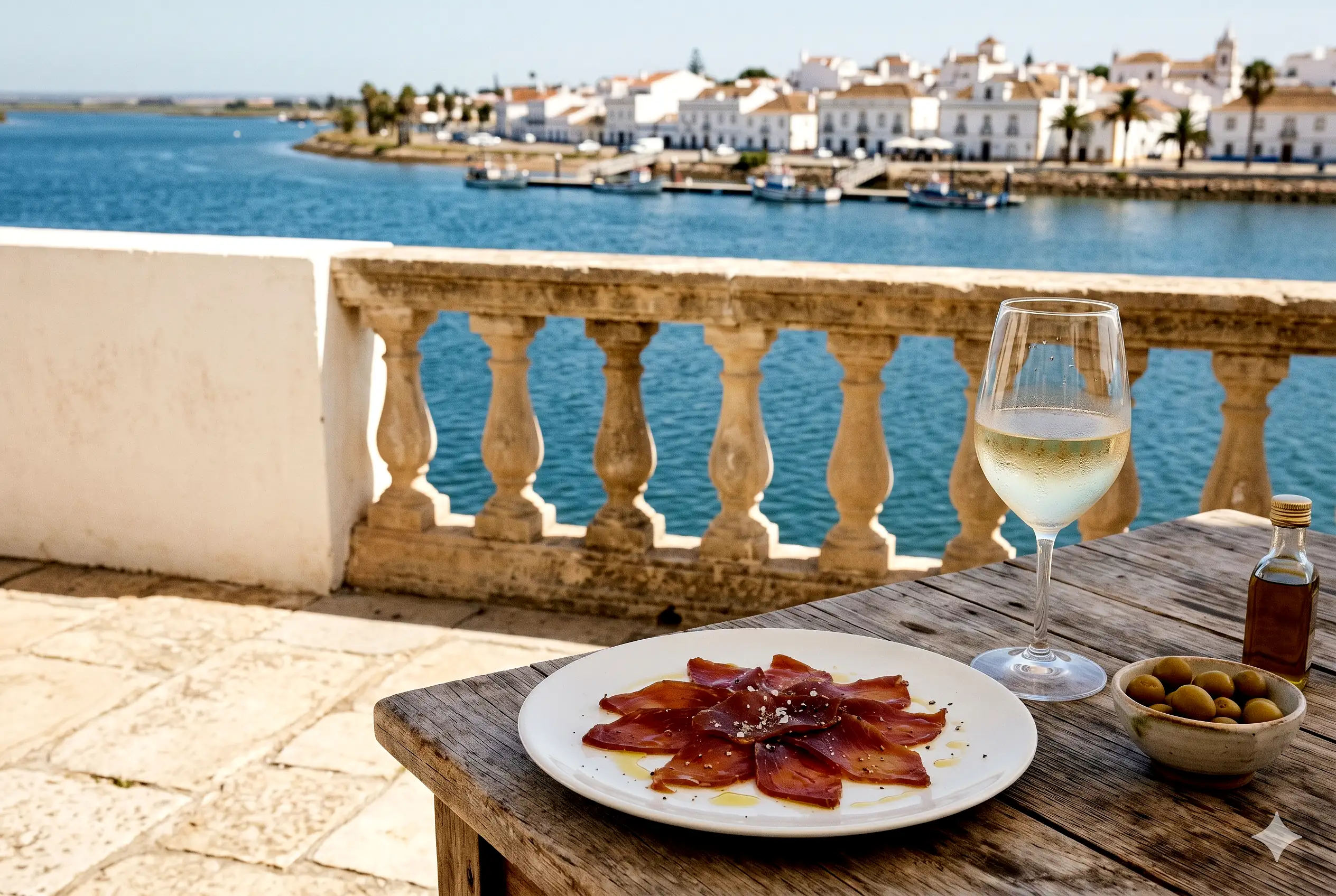
The second is mojama. Cured tuna — salt-packed for days, then air-dried for weeks until it becomes dense, dark, and intensely flavoured — is the local preserved speciality. It is sliced thin, drizzled with olive oil, and served as a starter or alongside a glass of fino. Two grades exist: Extra, cut from the central loin, and Primera. You will find it in every deli and on most bar menus. It is worth buying a vacuum pack to take home.
The third is jamón ibérico from Jabugo. The Huelva sierra, an hour inland from Ayamonte, produces what many consider the finest cured ham in existence: free-range Iberian pigs finished on acorns from the montanera oak forest, cured for three to four years. It is on every menu and every cutting board in Ayamonte. Order it simply, with bread if you want.
Tuna as a whole is central to the Ayamonte kitchen. The almadraba — an ancient Phoenician trap system of nets laid across the tuna migration route — is still operated in Huelva waters each May and June. The fish caught this way is different from farmed tuna: fattier, more flavourful, with a texture that holds up to both raw preparations and long-cooked stews. If you are visiting in May or June, this is the moment to order it grilled.
Where to Eat
A practical guide to the town's restaurants
Casa Luciano (Calle del Condado 1) is the most established seafood restaurant in Ayamonte. It has been here long enough to be the reference point locals name when asked where to send a visitor. The kitchen focuses on fresh fish and shellfish from the area in a straightforward Andalusian style — catch-of-the-day cooking, not elaborate presentations. The daily set menu runs around €30. It is the right first stop for a visitor who wants to eat what Ayamonte actually tastes like.
La Puerta Ancha (Plaza de la Laguna, 14) is the more design-conscious option — a creative kitchen that draws on local products but works them into more elaborate plates than the traditional tapas bar. If you want something closer to a restaurant experience, with more attention to the cooking and the room, this is where to go. Flamenco events run on Thursday and Friday evenings.
El Paladar is the best option for eating as the locals do: market-driven seafood tapas at low prices, in a room that is not oriented toward visitors. It consistently appears at the top of local recommendations for exactly this reason. Arrive at 14:00.
Bar Mesón El Choco is well-regarded for paella, seafood, and atmosphere — a reliable mid-range option with a consistent reputation across visitor reviews.
For views over the Guadiana river, the Restaurante Parador de Ayamonte is the setting. The Parador hotel sits on a hill above the town, and the restaurant looks across the river to Vila Real de Santo António on the Portuguese side. The food is honest Huelva regional cooking: jamón ibérico, raya al pimentón (skate in a smoked paprika and garlic sauce), squid stew with broad beans. It is not the best food in town, but the context — the panorama, the room — makes it appropriate for a longer lunch or a special occasion. TheFork rates it 8.7/10; expect around €25 per person without drinks.
For tapas and charcuterie, Delicatessen Merkajamón is the place to buy and eat mojama, jamón, and conservas — the preserved fish products (anchovies in vinegar, sardines in brine, mackerel fillets) that are a legacy of Ayamonte's canning industry.
The Market
C/ Prudencio Gutiérrez Pallarés, 10 — Monday to Saturday, from 7:30 AM
The Mercado de Abastos de Ayamonte is the clearest way to understand what this kitchen is built on. Around 25 stalls cover fresh fish and shellfish — brought in daily from the port auction — alongside meat, fruit, vegetables, artisan bread in a range of types, and Sierra products. The market bars serve coffee and churros from opening.
Come before 10:00 AM if you want the best fish selection. The market closes around 14:00; confirm hours on the day.
The Spanish Timetable
The single most important practical fact
Ayamonte eats on Spanish time, and Spanish time is different.
Lunch begins at 13:30 and peaks between 14:00 and 15:30. Most kitchens close at 16:30 and reopen for dinner at 20:30. Dinner peaks between 21:30 and 22:30.
Visitors arriving at 7 PM expecting a full restaurant will find most kitchens closed or still setting up. This is not a failure of service — it is simply the rhythm of the day. The solution is to plan around it: drive over for lunch, aim for 14:00, eat well, and drive back in the late afternoon. Or plan a late dinner at 21:00 and make an evening of it.
Tipping is not expected in Spain. IVA (VAT) is always included in prices. If you want to leave something, rounding up or leaving a few coins is the local custom — 5 to 10 percent would be considered generous.
What to Drink
Two wines worth knowing
The obvious pairing for shellfish and cured fish in Ayamonte is fino or manzanilla — the dry, saline-edged fortified wines from the Jerez and Sanlúcar appellation. A cold glass of fino with a plate of gambas blancas is one of the better food-and-wine pairings in Iberia. Ask for it at any bar.
The more unusual local choice is Vino Naranja del Condado de Huelva — a sweet, aromatic wine made from a base of white Condado wine macerated with orange peel and aged in a solera system for a minimum of two years. The grapes are Zalema, Palomino Fino, and Pedro Ximénez; the result is orange-scented, not cloying, and served slightly chilled. It works as an aperitif, alongside jamón and smoked products, or with dessert.
Beyond the Town
The Portuguese side of the river, and further along the Spanish coast
Vila Real de Santo António is about fifteen minutes from Ayamonte by international ferry (there is a dock just below the old town) or ten minutes by car via the bridge. It is a Pombaline planned city — built in the same rational grid as Lisbon's Baixa after the 1755 earthquake — with a riverfront promenade and a cluster of seafood restaurants that complement the Spanish side rather than competing with it.
Restaurante Cuca (R. Dr. Sousa Martins 60, 8900-299 VRSA) is the most consistently recommended option: a no-frills seafood house known for fresh fish and tomato rice. It is popular and best booked ahead.
If you are heading back via the inland route, Castro Marim is worth a short stop — a medieval castle village above the salt pans with a nature reserve. In the nearby village of Altura, A Chamine (Avenida do Hotel) serves regional Portuguese cooking with the signature cataplana de ouro at around €25 per head.
Back on the Spanish side: Isla Cristina, 20 minutes west of Ayamonte along the Huelva coast, is one of the main fishing ports for mojama and almadraba tuna — a working port with a different character than Ayamonte, and a strong seafood restaurant scene of its own.
Why We Are Here
Sun Villa, Costa Esuri, and what the location means
Sun Villa sits in Costa Esuri because of what surrounds it — not despite it. The proximity to Ayamonte's port, its market, and its kitchen is part of what makes a stay here different from a beach resort. Guests who want to eat well, shop locally, and move freely between Spain and Portugal find more here than in a purpose-built holiday strip.
The properties LusiberiaStays manages are in places where something is actually happening — a food culture, a landscape, a history of production. Ayamonte has all three. The mojama cured here, the shrimp landed here, the ham that has come down from the sierra for generations — these are not amenities we add to the experience. They are the experience. We do not need to create a context. We just need to help guests find it.
The Bottom Line
The best thing about Ayamonte's food scene is that it has not been designed for you. The market opens early because the port has been running since before dawn. The restaurants fill at 14:00 because that is when the town eats. The mojama tastes the way it does because this is where it has always been made.
Eat here on its terms, and you will eat very well.
Getting into Town from Costa Esuri
The Sun Villa is in Las Lomas, on the Costa Esuri development on the western edge of Ayamonte. The town centre is 10 to 15 minutes by car. Parking is straightforward and inexpensive. The old town and riverfront are compact and walkable once you arrive.
Vila Real de Santo António on the Portuguese side is 10 minutes by car via the international bridge, or about 15 minutes by ferry from the Ayamonte dock below the old town. Lagos and Alvor are 30 to 40 minutes further west along the A22. Spain and Portugal share the same time zone — your phone will not change at the border.
Frequently Asked Questions
Sources & References
- THE 10 BEST Restaurants in Ayamonte — TripAdvisor (2026)
- La Puerta Ancha — TripAdvisor
- Casa Luciano — Frommer's Ayamonte
- Eating in Ayamonte — FascinatingSpain (2017)
- Ayamonte Hidden Gem — JourneyGourmet
- Best places to eat in Ayamonte — HuelvaHoliday
- Huelva Gastronomy — Fuerte Hoteles Blog
- Route of the White Prawn of Huelva — Fuerte Hoteles Blog
- Original Gastronomy Route — Turismo Huelva (official)
- Mercado de Abastos — TripAdvisor
- Restaurante Parador de Ayamonte — Paradores.es
- Restaurante Parador de Ayamonte — TheFork
- Ruta de la Tapa 2024 — Ayamonte Turismo
- Restaurants VRSA — TripAdvisor
- Vila Real de Santo António guide — AlgarveTips (2026)
- Mojama — Tasting Table
- Tipping in Spain (2026) — SpainOnFoot
- Local Foods in Huelva — TasteAtlas
- Orange Wine — Condado de Huelva DOP (official)
- Vino Naranja — Wine Wit and Wisdom (2020)
- Ayamonte — Andalucia.com
- Huelva MICHELIN Restaurants — Michelin Guide
- Restaurants Isla Cristina — TripAdvisor
- Acánthum closure — HelloChefs.es (2021)